Monday, March 18, 2019

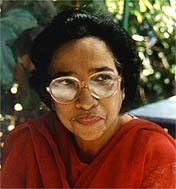
KRIPABAI SATTIYANANDAN – INDIA’S FIRST FEMINIST WRITER.


In the 1880s, a young woman from Madras raised her voice against the systemic degradation of women. She believed that if women had to rise to power, they should redefine feminity. Marriage and domesticity should not be the sole ambition of women. They had the right to live and not simply exist; the right to independent thought and intellectual pursuits. This brave woman was bold enough to communicate her convictions through her writing. She was the first Indian woman to write in English, and the first Indian feminist novelist.
Kripabai was born in 1862 at Ahmednagar, to Hindu parents Haripunt and Radhika Khisty. She lost her father at an early age and was brought up by her mother and brother. Her brother Bhaskar encouraged her to read a lot, and engaged her in discussions on then prevailing issues. Unfortunately he too died at a young age.
Kripabai converted to Christianity but she grew up observing both religions. Her education was sponsored by two European missionaries. She was the first woman to attend the Madras Medical College. She lived as a boarder in the house of Rev. W. T. Sattiyanandan. But because of her poor health, she had to discontinue her medical studies.
While boarding in the Reverend’s house, she fell in love with his son Samuel Sattiyanandan and married him. He was the Head Master of a school in Ooty. Kripabai used that time in Ooty to start a school for Muslim girls. She was a strong advocate of women’s education This was also the time when she started writing her articles and poems. They were published under the byline “An Indian Lady.” Her first published article was “A Visit to the Todas.”
Ill health dogged her footsteps and she had to return to the warmer climate of Madras in 1886, when she seriously began to write her first book “Suguna –Story of a Native’s Christian Life.” It was semi-autobiographical in which she also referred to her brother. Though she spoke Marathi, Tamil and Telugu, she found it easier to write in English in which she was fluent. During this time, she gave birth to a child who died before its first year.
Kripabai’s health gradually deteriorated. She was diagnosed with Tuberculosis which did not respond to treatment. She used this time to write her second novel “Kamala”- The story of a high caste Hindu woman caught in the grip of orthodoxy, and her life as a child bride, mother and widow. Some of it was written from her hospital bed.
Kripabai was an advocate of women’s education. She was passionately involved in women’s issues and decried decadent customs and superstitions. Some of her articles were unfinished at the time of her death in 1894.
Madras Medical College has perpetuated her memory by offering a scholarship to a woman candidate to study Pharmacology or go for higher Medical studies. Madras University too offers a medal to a female who stands first in English.
It is a pity that Kripabai died so young and could not see the progress of women in the 21st century.
           

Saturday, September 8, 2018

VICTORIA WOODHULL – A SOCIALLY SCANDALOUS ACTIVIST.


             Victoria Woodhull lived by her own rules and was a radical in many ways during her life time. She donned many hats as publisher, author, women’s rights activist and politician. She was hailed by some, scoffed at by others and disparaged by many. Yet she succeeded in leaving her footprints on the sands of Time.
            Born in Ohio, USA on 23rd September 1838, to an illiterate mother and a petty criminal father, Victoria had never been to school until she was eight, and then on and off for three years. She was forced by her father to become an itinerant clairvoyant along with the sister Tennessee, telling people’s fortunes and acting as a medium for contacting spirits. It brought in some money for their sustenance. But much later in life she gave up spiritualism and even derided spiritualist frauds.
            Victoria had many firsts to her credit. In 1868, along with her sister Tennessee, she became the first woman to run a Stock Brokerage Company on Wall Street, courtesy the wealthy industrialist Cornelius Vanderbilt to whom she provided ‘psychological solace.’ But being a woman, she could not get a seat in the New York Stock Exchange.
            In 1870 she published the “Woodhull and Claflin’s Weekly” and ran it for six years. In this paper she freely expressed her controversial opinions on social reform, women’s suffrage, birth control, and taboo subjects like free love and sexuality. Her paper was the first to print an English translation of the Communist Manifesto by Karl Marx and Frederich Engels.
            In 1871 through the influence of her friend Benjamin Butler a senator of Massachusetts, she became the first woman to address a Congressional Committee in the House of Representatives, on Women’s Rights. She said, “Women are the equal of men before the Law and have equal rights.” This brought her popularity and a position of leadership among the suffragettes. But a few years later, many of them became her fiercest critics, fearing that her unconventional lifestyle would put the Movement in jeopardy. When a comprehensive History of Women’s Suffrage was complied, her name was never mentioned.
            Victoria will go down in history as the first woman who ran for President of the United States in 1872. By then she had formed her own “Equal Rights Party” and contested on its ticket. But she was below 35 years of age which was the constitutionally mandated age for all candidates. No one took her candidacy seriously and she received no electoral votes.
            Victoria was also an author. Among her publications were “Stirpiculture or the Scientific Propagation of the Human Race” (1888) “Garden of Eden: Allegoric Meaning Revealed” (1889) and “The Human Body – The Temple of God.”(1890). She was an excellent speaker and even her critics recognized and acknowledged the power of her oratorical skills.
            Victoria became a target of public criticism because of her incorrigible lifestyle. She was thrice married and her first marriage was at the age of 15, to Canning Woodhull with whom she had two children. She was divorced after her first two marriages. During her time, divorce was socially scandalous and also limited by the law. Women who divorced were stigmatized by society. She had many other casual relationships too.
            Victoria was jailed along with her sister for publishing ‘obscene literature’ about Reverend Henry Ward Beecher and his clandestine affair with one of his parishioners.
            In 1877, Victoria and her sister moved to England. She continued to champion Women’s Rights and Women’s Suffrage, and spoke at many public functions. She finally settled down as a wife of a wealthy banker John Biddulph Martin in 1883.
            Along with her daughter, Victoria published a magazine “The Humanitarian” and ran it successfully for nine years. But after the death of her husband, she gave up publishing and retired to a village Brendon’s Norton in Worcestershire. She built a school there and became a champion of education in village schools.
            Victoria Woodhull died on June 9, 1927. Her life was a story of triumph over poverty, bad marriages, a hostile society and a sea of detractors. She was a woman of rare courage and stood up boldly for her convictions.


Friday, March 16, 2018

BAYA MAHIEDINNE – PICASSO’S INSPIRATION.


            Some people are born artists and Baya or Fatima Haddad of Algeria was one such gifted person. Born in 1931 at a village called Bordj El Kiftan in Algeria, her talent for painting was evident even before the age of ten.
            Orphaned at the age of five, she was brought up by her grandmother. As a teenager she worked in the house of a French lady Marguerite Caminat, as a domestic help. This lady spotted her talent and encouraged Baya to draw and paint, even supplying her with paint, paper and whatever else she required. Later, Baya was legally adopted by her.
            Marguerite was well connected in the Art and Literary world. She showed Baya’s paintings to an Art dealer Aimee Maeght. Impressed by her talent, Aimee who was the Director of Maeght Art Gallery in Paris, organized a solo exhibition of Baya’s paintings in 1947. She was just sixteen years old and found herself suddenly in the limelight.  Andre Breton, Founder of the Surrealist Movement was impressed by her work and saw in her paintings a surrealistic dream like quality. In the Exhibition Catalogue he wrote that he was “promoting the beginning of Queen Baya.”
            But Baya refused to have her work compartmentalized under any genre. “I am a free spirit and paint the world within me,” she said. “When I paint I am happy. I am in another world. I forget everything.”
            Picasso met the teenaged Baya and was impressed with her work and the spontaneousness in her figures. In 1948 he invited her to work with him. It was a case of mutual admiration. They inspired and appreciated each other’s work. Though Picasso was fifty years older than her, she gave him fresh perspective and inspired him to paint a collection of women called “Women of Algeria.” An Art historian commented “Picasso nurtured Baya’s aesthetic – particularly her use of colour and line, while Baya’s cultural vitality served as a creative life blood for Picasso.”
            In 1952 Baya married an Algerian musician and composer Maheidinne Mahfoudh. Baya threw herself into domesticity, temporarily forsaking painting, to bring up six children in the years between 1953-1963. But she returned to painting in 1967 with renewed vigour. She was completely self- taught and painting was her passion. Totally illiterate, she could barely sign her name.
            Baya’s output was copious. Her subjects were women in colourful dresses, children, animals, flowers, fish and butterflies. Her colours were vibrant, her outlines bold and well defined. Baya’s work was exhibited in Paris and Algeria. Some of her paintings were printed on postal stamps. She also tried her hand at pottery.
            Critics called her work primitive, naïve or surreal. Some saw similarities with Islamic or African tribal art. It did not bother her or affect her work. She only allowed her environment and imagination to influence her artistry.
            Though invited to settle in France, Baya preferred to stay in Bilda Algeria until her death on November 9th, 1998. This humble lady’s tribal art fascinated the western world.
           

Monday, January 8, 2018

COUNTESS ADA LOVELACE – ENCHANTRESS OF NUMBERS.


The digital world today hardly remembers “The Mother of Computer Science” – Ada Lovelace, who wrote the first computer program in 1837, while she was still in her teens.
            Ada Augusta was the daughter of the poet Lord George Gordon Byron, who suffered bouts of insanity and was notorious for his erratic behaviour. He abandoned his family when Ada was only a month old, either because he felt intimidated by his highly intelligent wife Anne Isabella Milbanke, Baroness of Wentworth, or because Ada was not the ‘glorious boy’ the couple had expected.
            Ada was born on the 10th of December 1815, in London. She grew up under the care of her maternal grandmother Judith, Lady Milbanke. Her mother had little affection for her and distanced herself from her child. She was always afraid that Ada would show signs of insanity like her father. Though physically distanced from Ada, she made sure that her daughter got a sound education through the best of private tutors. Maths, Logic and Science were subjects that took precedence over French and Music. She kept a close watch on Ada’s progress and berated her if she didn’t do well in her studies.
            From an early age, Ada showed a keen interest in Maths. She also had a fascination for machines. At the age of 8 she modelled boats. At 13, she designed flying machines. But Ada was not a very healthy girl. In 1829, she was paralyzed after an attack of measles and was incapacitated for a year. She had to walk with crutches until 1832. But nothing could mask her brilliant mind. She was presented at Court when 17, and became the belle of the season because of her brilliant mind.
            The highlight of Ada’s life was her meeting in 1833 with Charles Babbage, a Mathematics professor at the University of Cambridge. He was called the ‘Father of Computing’ and invented the first programmable computer – The Analytical Engine. He invited mother and daughter to view a small version of this calculating machine. Ada was determined to find out how it worked and asked for the machine’s blueprints. Her enthusiasm was such that she became the world’s first computer programmer, publishing the Bernoulli Number Algorithm. Ada was convinced that it would not just remain a calculator but would contribute to other areas like music, alphabet, images that could be converted into computer algorithms.
            Ada was married at the age of 19 to William King, Earl of Lovelace, and bore him three children in quick succession between 1836 -1839. But she had inherited from her father a flirtatious tendency and her affairs led to gossip among her mother’s friends. Ada was also a gambler and lost scandalous amounts on horse races.
Ada Lovelace 
            Ada’s greatest friend and mentor was Mary Somerville a famous mathematician. Together they discussed high level maths and also about Charles Babbage’s machine. It was Charles who called Ada ‘Lady Fairy’ and ‘Enchantress of Numbers.’
            Though Ada’s mother tried to poison her mind against her truant father and showed her his photograph only when she was 20 years old, Ada secretly harboured a soft corner for Byron. On November 27th 1852, Ada died at the age of 36, from uterine cancer. According to her dying wishes, she was buried beside the grave of her father in the Church of St. Mary of Magdalene, Hucknall, Nottingham.

            Ada Lovelace Day commemorates her genius. It is a day when Women International celebrities in Science, Technology, Engineering and Maths (STEM) are recognized and felicitated. It was first celebrated in 2009, and is now annually observed on the 2nd Tuesday in October.

Saturday, September 2, 2017

MIRIAM MAKEBA – THE SINGING MAMA AFRICA.

                                   
Miriam Makeba a singer of international repute, who enthralled the world with her dynamic voice for over three decades, was born in Johannesburg, on 4th March 1932. Her father Caswell worked as a clerk and her mother Christine worked as a domestic help,
but was also a spiritual healer. When her mother was imprisoned for brewing illicit beer, Miriam as a child of 18 months was taken along and spent six months in jail.
            After her father’s death, Miriam lived with her grandmother in Pretoria, where she was encouraged to sing in church. In 1947, at the age of fourteen, Miriam gave her first solo in church during a Royal visit.
            Miriam lived up to her middle name ‘Zenzi’ (meaning you have no one to blame but yourself) by taking charge of her destiny early in life. She soon realized that her voice was her ticket to freedom. But she was also aware that as long as there was Apartheid in South Africa, there was no hope of a career in music.
            Africans were known for their musical creativity and improvisation skills in rhythm, tonal qualities and verbal content. African jazz and ragtime was combined with Anglican Church music to form a distinct vocal style called Mbube. For a while Miriam sang with the Cuban Brothers. She was also a member of the all female group called the Skylarks. In 1954, she joined a pop band called Manhattan Brothers. This advanced her singing skills. She had a wide voice range and her songs were poignant with emotion and touched the hearts of her audience. With Manhattan Brothers she toured Rhodesia (Zimbabwe) and Congo. In 1957, the band toured the rest of Africa for 18 months, with Miriam as its soloist of African Jazz and traditional African music.
            In a movie King Kong the story of a South African boxer, she was given the female lead.
International recognition came to her through her singing part in “Come Back Africa” a documentary of Black life in Africa. The Director Lionel Rosogin a white man invited her for its screening at the Venice Film Festival in 1959, which made her an instant celebrity.
            From there she flew to New York where Harry Belafonte took her under his wing. Miriam lived in Greenwich Village with other actors and musicians. She met film stars life Bing Crosby and Marlon Brando and musicians Ray Charles, Louis Armstrong and others. In 1962 Miriam appeared with Marilyn Monroe at John Kennedy’s birthday celebrations in Madison Square Garden. In 1966, she won the Grammy along with Harry Belafonte for their album “An Evening with Belafonte and Makeba.”
            Miriam was one of the first African musicians to bring African music to western audiences. Some of her songs were critical of Apartheid. Nelson Mandela said, “Her music inspired a powerful sense of hope in all of us.” In 1962, she testified at the UN Committee against Apartheid and asked for economic sanctions and arms embargo against the government in South Africa.
            In 1985, for the first time in Britain, she sang at the Royal Festival Hall, London. It was on her 53rd birthday. Many criticized her for being anti-White. But she answered, “People have accused me of being a racist but I am just a person for justice and humanity. People say I sing politics. It is the truth. I’m going to go on singing and telling the truth.”
            Over the years, Miriam became identified with Black Consciousness. She was acutely antagonistic to Apartheid and the white minority government in South Africa. She became a vociferous activist and a champion of Black power. She took part in fund raising for these groups and held a benefit concert in aid of Martin Luther King Jr’s Southern Christian Leadership Conference. Emperor Haile Salassie of Ethiopia invited her to sing at the inauguration of the Organization of African Unity.
For her anti-apartheid activities Miriam was banned from entering South Africa for 30 years. She could not even attend the funeral of her mother who died during the Sharpeville Massacre. However, she became an honorary citizen of 10 countries. In her autobiography published in 1988, she wrote about the demeaning aspects of Apartheid. Miriam was able to enter South Africa only after the end of Apartheid, when she sang at the function felicitating Nelson Mandela after   his release.
            Miriam’s personal life was something of a tragedy. She gave birth to a girl called Bonzi at the age of 17. Soon after, she was diagnosed with Breast Cancer. She claimed that she was healed by her mother’s herbal and spiritual administration. A decade later, she developed cervical cancer and had to undergo surgery.
Rather unconventional in her life style, she had five husbands at different periods of her life.
            Miriam’s best known songs are ‘Malaika’, ‘Pati Pati’ and the Click Song and are sung even today. Her output consisted of 30 original albums and 19 compilation albums.
            Miriam died at the age of 76 in Naples, on November 9th, 2008. This singing ‘Mama Africa’ as she was popularly known, had sung for thirty minutes at a concert in aid of a movement against organized crime, when she suffered a massive heart attack.
As Pearl Buck said, “The secret of joy in work is contained in one word – Excellence. To know how to do something well is to enjoy it.”


Thursday, June 1, 2017

VIVIAN MAIER – STREET PHOTOGRAPHER

                                    
.
“Full many a flower is born to blush unseen and spread its fragrance on the desert air,” wrote the poet Gray. If a young man named John Maloof had not discovered the wealth of photographs taken by Vivian Maier, the world would have never known of the street photographer who called herself ‘a sort of spy.’
            Vivian was born in France on February 1st, 1926. She was of mixed descent with a French mother and an Austrian father, who abandoned his family when she was a child. A portrait photographer named Jeanne Bertrand befriended her mother. Perhaps Vivian’s interest in photography was nurtured by this lady.
            In her youth, Vivian shuttled between France and USA until in 1951, she settled down in New York. She was an intensely private person, eccentric but intelligent, and cared nothing for what people thought about her. Shabbily dressed in a long loose dress with a baggy woollen overcoat, solid boots and floppy hat, she never stepped into the street without her camera dangling from her neck. Her first camera was a simple box camera. Objects and people on the streets fascinated her.
            Vivian came to New York as nanny to a family who sailed to USA from Southampton. She continued to work for the family between 1951 and1956, and could now afford to buy a more sophisticated Leica IIIc, with which she could take coloured photographs. From photographing objects and landmarks, she now turned to capturing people in her films. She had a great affinity for the poor, their life styles, and their struggles. Whatever caught her eye she photographed and documented. She also developed an inexplicable urge to hoard things. Newspapers, garbage cans, discarded items on the roadside were collected and stored in boxes.
            In 1957, Vivian moved to Chicago where she again sought employment as a nanny to three children. They were here closest family. She was like a second mother to the children, fond of them but also very strict. When she took them outdoors, she was also busy photographing whatever caught her fancy. She had a small room to herself which doubled as a dark room to develop her pictures. She also had access to the attic in which she hoarded her collection of newspapers, clippings, film rolls and other knick knacks. The attic was always locked permitting no entry to the children.
            During her tenure as a nanny, she would make short trips to other parts of the country, Canada, South America, and some cities in Europe. She always travelled alone and indulged freely in her hobby of photography.
            By the early ‘70s the children had all grown up and needed no nanny. She moved from family to family in Chicago and nannied in this city for a total of seventeen years. But she could no more develop her rolls of film. They had to be put in boxes with all the other junk she had accumulated. In 1980, she stopped photographing, and her camera too went into storage.
            Vivian managed to live in a tiny studio apartment which was paid for by one of the families for whom she had worked. But when she could not pay the rent to the storage companies, one of her storage bins was auctioned without her knowledge, to cover the rent.
            In 2007, John Maloof a young man was writing a book about Chicago. He visited the local auction to see if he could get photographs or material for his book. Paying $400/- he bought one of her boxes which contained hundreds of negatives depicting scenes from Chicago. He became obsessed with Vivian’s work and started buying back stuff from other buyers who had attended the auction. He also acquired items from her other two boxes.
            Within a year, John had salvaged about 90% of her work. There were 100000 to 150000 negatives, 3000 prints, hundreds of rolls of film and audiotapes. She had methodically documented many of the photographs. Vivian Maier became John Maloof’s magnificent obsession.
            In 2008, Vivian skidded on ice and injured her head. She never recovered and died in a nursing home on April 21st, 2009.

            The first story about Vivian was published in 2009. Her life and works not only became Maloof’s passion but also contributed to his livelihood. The first exhibition of her work was in 2010. These were scans of all her negatives. Since then this exhibition has travelled all over USA, from Chicago to Los Angeles to New York. It has been exhibited in many European countries as well. So well archived, it has rekindled an interest in street photography and in the life and work of an extremely private woman who was a law unto herself.

Friday, January 6, 2017

MARIA BICKNELL – THE BABY MACHINE.


Maria Bicknell was the daughter of Charles Bicknell, a solicitor to the Prince Regent and the Admiralty. She lived with her parents in London, but would often visit her grandfather in Suffolk. He was Dr. Durand Rudde, the Rector of East Bergholt and also a very wealthy man.
Maria first met the impoverished landscape painter John Constable when she was twelve and he was twenty. They met again when she was a few years older, and love came unbidden into their hearts. But Constable was living on a measly allowance of 100 pounds a year from his father, which was scarcely enough for his own sustenance. They had to carry on their secret affair for seven long years, until the death of his father when he inherited sufficient amount of money to support a wife.
Their marriage was stoutly opposed by both families. Maria’s grandfather threatened to disown her, as Constable belonged to a lower social stratum. His father was not an intellectual but a trader, even though he owned a prosperous mill. Besides, Constable’s paintings did not bring in a regular income.
Though Constable was a landscape painter and an ardent exponent of naturalism, he occasionally undertook portrait painting because of financial necessity. Three months before their marriage, he painted a portrait of Maria. She was in London and Constable wrote from Suffolk, “I would not be without your portrait for all the world. The sight of it calms my spirit in all trouble.”
Their marriage took place in 1816, at the Church of St. Martin Fields in London. Neither family attended the wedding. But their steadfast love carried them through stiff opposition of their families and also through severe financial hardships. Charles Bicknell gave his daughter 50 pounds a year. But when her grandfather died, she received 4000 pounds as part of her inheritance.
Maria bore seven children in quick succession. She also had one miscarriage. Perhaps in those days the subject of contraception was taboo, and the young couple had no clue about Planned Parenthood.
Frequent child bearing took a toll on Maria’s health. She contracted tuberculosis and died at the age of 41, a few months after delivering her seventh child. On November 23rd, 1828, she was buried at St. John-at-Hampstead Churchyard in London.
On her death, Constable went into deep depression. He was unable to concentrate on his paintings. His clients were dissatisfied with his work and grumbled.
“I am intensely distressed and can hardly attend to anything,” he apologized.
To add to his loss, he was saddled with the responsibility of looking after seven children.
He wrote to his brother, “I do feel the loss of my angel. God only knows how my children will be brought up. She was a devoted, industrious, religious mother who was all affection. …….The face of the world has totally changed for me.”
            Their married life lasted for a mere twelve years. Frequent child bearing and tuberculosis had debilitated Maria. Death dealt the coup de grace.