Showing posts with label Algeria. Show all posts

Friday, March 16, 2018

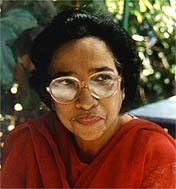
BAYA MAHIEDINNE – PICASSO’S INSPIRATION.


            Some people are born artists and Baya or Fatima Haddad of Algeria was one such gifted person. Born in 1931 at a village called Bordj El Kiftan in Algeria, her talent for painting was evident even before the age of ten.
            Orphaned at the age of five, she was brought up by her grandmother. As a teenager she worked in the house of a French lady Marguerite Caminat, as a domestic help. This lady spotted her talent and encouraged Baya to draw and paint, even supplying her with paint, paper and whatever else she required. Later, Baya was legally adopted by her.
            Marguerite was well connected in the Art and Literary world. She showed Baya’s paintings to an Art dealer Aimee Maeght. Impressed by her talent, Aimee who was the Director of Maeght Art Gallery in Paris, organized a solo exhibition of Baya’s paintings in 1947. She was just sixteen years old and found herself suddenly in the limelight.  Andre Breton, Founder of the Surrealist Movement was impressed by her work and saw in her paintings a surrealistic dream like quality. In the Exhibition Catalogue he wrote that he was “promoting the beginning of Queen Baya.”
            But Baya refused to have her work compartmentalized under any genre. “I am a free spirit and paint the world within me,” she said. “When I paint I am happy. I am in another world. I forget everything.”
            Picasso met the teenaged Baya and was impressed with her work and the spontaneousness in her figures. In 1948 he invited her to work with him. It was a case of mutual admiration. They inspired and appreciated each other’s work. Though Picasso was fifty years older than her, she gave him fresh perspective and inspired him to paint a collection of women called “Women of Algeria.” An Art historian commented “Picasso nurtured Baya’s aesthetic – particularly her use of colour and line, while Baya’s cultural vitality served as a creative life blood for Picasso.”
            In 1952 Baya married an Algerian musician and composer Maheidinne Mahfoudh. Baya threw herself into domesticity, temporarily forsaking painting, to bring up six children in the years between 1953-1963. But she returned to painting in 1967 with renewed vigour. She was completely self- taught and painting was her passion. Totally illiterate, she could barely sign her name.
            Baya’s output was copious. Her subjects were women in colourful dresses, children, animals, flowers, fish and butterflies. Her colours were vibrant, her outlines bold and well defined. Baya’s work was exhibited in Paris and Algeria. Some of her paintings were printed on postal stamps. She also tried her hand at pottery.
            Critics called her work primitive, naïve or surreal. Some saw similarities with Islamic or African tribal art. It did not bother her or affect her work. She only allowed her environment and imagination to influence her artistry.
            Though invited to settle in France, Baya preferred to stay in Bilda Algeria until her death on November 9th, 1998. This humble lady’s tribal art fascinated the western world.
           

Wednesday, April 10, 2013

ISABELLA EBERHARDT – A VAGABOND BY CHOICE.


About 45 kms east of Morocco is Ain Sefra, Algeria, the gateway to the Sahara Desert. It was once a 19th century French Garrison Town that was destroyed by a flash flood in 1904 – the very same flood that killed the young Swiss explorer and writer Isabella Eberhardt, who had made Algeria her home.
Isabella was a law unto herself. One seldom sees such rare courage in a young woman of twenty, who threw conventional morality to the winds and insisted on her right to be a vagrant with the freedom to wander and to live life according to the dictates of her own conscience.
Isabella Eberhardt was born in Geneva on February 17th 1877, to a German Russian mother Natalie Eberhardt and an Armenian anarchist father Alexandre Trophimowsky. She was registered as an illegitimate child and therefore never needed to recognize Trophimowsky’s paternity. Perhaps her mixed genetic pool contributed to her erratic behaviour which shocked the world.
Isabella was well educated and fluent in several languages like French, German, Russian and Italian. She even learnt Latin and Greek and was specially tutored by her father in Arabic Classics and the Koran. The Koran so influenced her faith that she called Islam her true calling.
In 1897 she moved with her mother from Geneva to North Africa where they both embraced Islam.
Isabella was always dressed like a man to enjoy freedom of movement in Arab Society. She re-christened herself Si Mahamoud Essadi and joined a secret Sufi sect called Qadiriya, to help the poor and needy. She also encouraged Muslim locals to fight against French Colonial rule.
Isabella traveled extensively as a Muslim man. She rubbed shoulders with vagrants and vagabonds and squandered her meager resources on drugs and drinks, and bedded with any man who pleased her. Her endless wanderings gave her intimate knowledge of the lives of the poor and powerless. She believed that vagrancy was deliverance from conformity and freedom from the burdensome shackles of society. It was the route to self-purification. 
She said,“Such men can reach the magic horizon where they are free to build their dream palaces of delight.”
Perhaps the Hippie Movement drew its inspiration from her.
            As a creative person, she was a keen observer of people and practices around her. Her experience of low life made her a sensitive human being. Her short stories are so compelling. Her diaries are packed with fascinating information of her life and times. Not for her the beaten track. Derision  and ridicule by society left her unfazed.
“As a nomad who has no country besides Islam and neither family nor close friends, I shall wind my way through life until it is time for everlasting sleep beyond the grave,” she wrote.
It is difficult to understand how she reconciled her faith in Islam to her depraved life style.
            Isabella was not the darling of Algerian Society and must have earned the ire of many holy men. In 1901, she was attacked by a man who severed her arm. But this magnanimous lady not only forgave him but pleaded for his life.
            Later that year in October 1901, Isabella married an Algerian soldier called Slimane Ehnni, in Marseilles. But they were seldom together because of his duties and her wanderings.
However in 1904, her husband joined her for a long break and they rented a house for the duration of his leave. Unfortunately on October 21st 1904, tragedy struck in the form of a flash flood and their clay house collapsed, killing Isabella. Her husband was washed away but he survived.
            Isabella Eberhardt was buried in the Muslim cemetery in Ain Sefra, according to Muslim rites. A trip to the cemetery can be made by car or by foot. Here, her restless spirit lies in peace, framed in by Mount Atlas on one side and the golden sands of the Sahara on the other.
Isabella’s “Algerian Short Stories” was published posthumously in 1905 and “In the warm shadows of Islam,” in 1906. A novella was made into a film.
            Isabella reached that “sun-drenched Somewhere” which she was always seeking for, sadly at a very young age. She was only 27 years old when she died.