
Wednesday, November 5, 2014

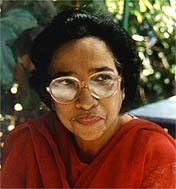
HELENE WEIGEL – MOTHER COURAGE.


            Chausseestrasse 125 in Berlin Mitte was the home of Helene Weigel, actress and Art Director of Berliner Ensemble, where she lived with her famous writer husband Bertold Brecht, from 1953 until her death in 1971. Her life is a fascinating story of courage, talent and determination. The guide who led us through this Memorial was so enthused with the lives of these two people that it left us hankering for more information.
            Helen Weigel was born in Vienna to Jewish parents. Her father Siegfried Weigel was the Accountant General of a textile factory and her mother Leopoldine Pollack, was the proprietor of a toy shop. Even at an early age, she showed her determination of becoming an actress. Much against her parents’ wishes, she started taking lessons in acting in 1917, and moved to Frankfurt. Helene was helped by Danish author Karin Michaelis to go on stage at 17. She acted for several years at the Frankfurt Theatre and Playhouse. She moved to Berlin in 1922, where she trained under Max Reinhardt, and worked at the Berlin State Theatre under the direction of Leopold Jessner.
            Helen was of short stature and her photographs show her as not so beautiful. But she had a deep and forceful voice that held her audience captive. She chose maternal roles like Mother, Mother Courage, Theresa Carair in Senora Carair’s Rifles and many others. These roles brought her fame as an actress.
            In 1928, she officially resigned from the Jewish community. She married the famous poet and playwright Bertold Brecht on April 10th, 1929, and performed in many of his plays.
She became a member of the communist party in 1930. Though Brecht was a believer in Marxism, he never really became a member. They were both opposed to Hitler and Nazism, and after the burning of the Reichstag in 1933, had to flee Germany. They were forced to spend fifteen years in exile in countries like Denmark, Sweden, Finland and finally in USA where they stayed for six years from 1941 to 1947. Helene couldn’t act during her years in exile but she continued with her voice and body exercises. Her German citizenship was cancelled in 1937, and Brecht’s in 1935.
            After the end of the war, Helene and Brecht returned to Berlin in 1949, via Zurich. Though Helene had reservations about East German totalitarianism, she was careful not to antagonize the party. So she was able to retain her position of Administrator and Director of the Berliner Ensemble till her death. Now Brecht was able to bring out his plays written in exile and have them played out on stage. The couple became prominent in German Theatre circles. Helene was able to produce and publish Brecht’s complete works as Director. She also acted in some of his famous plays.
            Though professionally they were a team, Helene had many challenges to battle. Brecht was a womanizer and his dalliance with various women brought about alienation in their marital relationship. While he stayed on the first floor of the house on Chausseestrasse, she moved to the second floor. They had a common kitchen on the ground floor. Brecht’s apartment has been retained as it used to be in his life time, with an assortment of tables, chairs and faded sofa sets, his typewriter, his writing implements and books. His bedroom and bed on which he breathed his last are also preserved. He died of a heart attack brought on by a viral infection in 1953. Helene continued to live in the same building till her death. She moved into a modest ground floor apartment overlooking a small garden. Her 2nd floor apartment was converted into the Bertold Brecht Archive which houses all her husband’s work. It was a labour of love. She was the executor of his estate.
            Helene was a philanthropist. She gave generously to orphanages and charities. She was known for her strength, energy, diplomacy and humour. She held open house for actors and friends and was an excellent cook. While in USA, she sent food packages to starving artists. Bertold Brecht commented on her modesty as an actress. “Never did she set out to show her own greatness but always the greatness of those she portrayed.”
            During her years in exile she was under surveillance of the FBI. She never lost her sense of humour and invited the FBI agent to come indoors from the cold so that he could observe her closely. She was also spied upon by the East German police.
            In 1950, she became the founding member of the German Academy of Arts. In 1954, she stood as a candidate for the SED party in parliamentary elections. Helene was awarded the National Prize of GDR in 1949, 1958 and 1960. She was bestowed the Patriotic Order of Merit in Silver, and also the Clara Zetkin medal.
            Helene was a chain smoker and suffered from lung cancer. In her last year of life she gave up smoking. But she died of multiple fractures sustained after acting for the last time in Paris. She died on May 6th, 1971, fifteen years after her husband’s death. Their house was open to the public in 1978. One is only permitted a guided tour to the first and ground floors.

            The couple is buried side by side in the neighboring Dorotheen Stadischer Friedhof, with simple rock headstones on which their names are engraved. 

Sunday, May 25, 2014

QUEEN KETEVAN – A MARTYR FOR HER FAITH.


             Many people have been martyred for their faith. Some are well known, and people regularly pay homage to them as saints. Others like Queen Ketevan are almost forgotten.
Ketevan lived in the 17th century. She was queen of Kakheti in Eastern Georgia, by virtue of her marriage to Prince David I. Following his death in 1602, his brother Constantine I murdered his father Alexander II the reigning king, with the help of the Iranian Shah Abbas I of Persia. The brave queen rallied the Kakhetin nobles against Constantine’s forces and vanquished them.
            Shah Abbas I of Persia was a ruthless man. He was determined to wipe out Christianity from Eastern Georgia. Churches were razed to the ground, statues broken and crosses destroyed. Gold jewellery and precious stones were carried away for his queens and concubines. Almost 60,000 Georgians were slaughtered and many more, deported to Persia.
            In 1614, Queen Ketevan went to the Shah with two requests. One was to stop his forces from invading Kakheti and more importantly, to help enthrone her son who was underage, as king of Kakheti, while permitting her to function as regent.
            But instead of help, she was taken hostage and held captive in Shiraz for many years. He ordered her to renounce Christianity and convert to Islam because he wanted her in his harem. When Ketevan stubbornly refused to do so, she was subjected to horrendous torture. Burns were inflicted on her body by red hot irons. Finally after years of imprisonment, she was strangled to death with a bow string on 22nd September 1624.
            The St. Augustine Catholic missionaries witnessed her gruesome death.  Four months later, her body was exhumed. Part of her remains was interred in the Alaverdi Monastery in Georgia. The rest of it was carried to Goa in India, where it was preserved in a vault of black stone, in the church attached to the Augustinian monastery.
            The Augustinians abandoned the monastery in 1835, as Georgia withheld support to all religious groups. The church crumbled in 1931, leaving just a part of the church tower standing erect. In 1991, the Russian Embassy made a formal request to India for her remains, as there was renewed interest by the Church to give Queen Ketevan a proper burial in her own country. The Archaeological Survey of India got to work excavating the ruins of the Augustinian church and monastery. The relic hunt ended only in 2013, when a few bone fragments were unearthed from below the window of the church. Genotyping of the mitochondrial DNA of the fragments ruled out the possibility of them being of Indian origin. However, that particular DNA was common in people living around Georgia.
            Ketevan was canonized as a saint by the Georgian Orthodox Church. She was a fearless woman who showed the world that her religion was of incalculable value and was worth any sacrifice. Georgians celebrate her feast on the 13th of September every year.

Monday, March 17, 2014

GALA – MUSE OF SALVADOR DALI.


Girona in N.E. Catalonia is famous for its association with the surrealist painter Salvador Dali. From Barcelona there are day trips to important museums in Girona depicting his life and work. But the Gala-Dali Castle in Pubol is special, as it was a gift to Dali’s wife and muse Gala.
When Dali bought this mediocre castle in 1969, it was a dilapidated structure with walls cracked and crumbling. The garden was overrun by thorns and bramble. Dali turned it into a beautiful palace for his wife, decorating it with painted frescoes and costly antiques. It was mutually agreed that he would not visit her there without her prior permission. Gala spent her summers in this castle between the years 1971-1980.
Gala was of Russian origin. Born Elena Dmitriovna Diakonova, she was a highly intelligent and intuitive woman. She grew up in Moscow, and though she lost her father at the age of eleven, her stepfather saw that she received a good education. She graduated with honours from the Brukhonenka Academy. Though there were many restrictions on women, she was able to give private tuitions and teach at a primary school with a special decree from the Czar.
Unfortunately, Gala contracted Tuberculosis in 1912 and had to be shifted to Clavadel Sanatorium in Switzerland, where she became romantically involved with a fellow patient Paul Eluard, a French poet. They were married in Paris in 1916. Eluard introduced her to many literary personalities and some artists of the surreal movement. Gala was a woman with an incredible sex drive. Even while married, she had an affair with Max Ernst who painted her portrait.
Salvador Dali met Gala and her husband in 1929, when he went to Paris to present a film he had made. He soon became friends with the couple and invited them over to spend summer with him at Cadaques. This was when he fell deeply in love with Gala, a married woman ten years his senior. Dali was just 25 years old when they met. In his diary he wrote, “She is destined to be my Gradiva, the one who moves forward my victory.” 

They started living together in 1934, and she became his muse and greatest inspiration all through his wildly eccentric life. Gala was the model for most of his portrait paintings, which are now in the Dali Museum at Figueres. Sometimes she was portrayed as a seductress, sometimes as a nun. Enigma of Desire, My Mother, Madonna of Port Lligat are some of the paintings that take one’s breath away.
Because of Dali’s eccentricities he was expelled from the surrealist movement in 1934. The couple spent eight years in the United States. But in 1948, they returned to Spain. They were married in 1958, in a Catholic ceremony at St. Angel’s Church in Girona, after living together for twenty four years. Spring and summer were spent in Spain, but in winter they shifted to Paris or the United States.
Theirs was a bizarre surreal relationship. Dali was aware of her many affairs. He even encouraged her flirtations as he was a practitioner of Candaulism – a sexual practice in which a man exposes his female partner or pictures of her to other people for their voyeuristic pleasure.
Even in her late 70s, she had a wild fling with a Rock Star Jeff Fenhoit. When she tired of him, she presented him with a Dali painting and a million-dollar house in Long Island.
            Gala was aware of Dali’s weak character, his vacillating moods and his megalomania. She took control of his life and his business affairs. There were rumours that she even turned him into a Valium addict. Towards the end, Dali began to despise her. But neither was he able to function without her.
            Gala died on June 10th 1982 at the age of 87. Dali outlived her by five years. But by then he was mentally unhinged. Gala is buried in the Pubol Castle grounds. The beautiful castle was opened to the public in 1996. It can be visited between March and December. It gives one an idea of the luxurious way she lived.
            Despite all his eccentricities, Salvador Dali was one of the greatest surreal artists of the 20th century. He has immortalized Gala through his many paintings and Castle Pubol is his monument of love.

Saturday, January 18, 2014

AGNODICE – FIRST FEMALE GYNAECOLOGIST.


You may walk the length and breadth of Athens but you will never find the house where Agnodice lived nor will you find her last resting place. Modern Athens was rebuilt on an ancient city and Agnodice lived in the 4th century B.C. This has given rise to the belief that she is only a mythical figure. But whether her story is fact or fiction, it is something worth reading about. Her story was first documented by writer Hyginus in 1st century B.C.
            Agnodice always wanted to be a doctor. But women in Greece were prohibited from studying Medicine. So great was her ambition that she cut her hair and dressed like a man. Under this guise she was able to enroll under physician Herophilus in Alexandria. A brilliant student, she graduated with the highest marks in 350 B.C.
After completion of her medical studies, Agnodice returned to Athens and started her practice. Her popularity got her into trouble with other doctors, who said that “he” was seducing and corrupting married women. Women in those days, preferred to be treated by midwives rather than male doctors. Maternity and Infant mortality was very high. Moved by the pain of a woman in the throes of labour, Agnodice volunteered to treat her. But the woman refused, taking her for a male doctor. So Agnodice revealed herself as a woman by lifting up her skirts to show her female body.
Now women flocked to her for treatment. It made fellow doctors extremely jealous. They wanted her punished for deceit and false pretences. It was also against the law for a woman to practise medicine. The courts meted out the death sentence. But her loyal female patients including the wives of her accusers marched into court in her defence.
“You men are not spouses but enemies since you are condemning her, who discovered health for us,” they said.”If Agnodice is executed, then we will all die with her.”
So powerful and convincing was their defence that the court acquitted her. Soon the law prohibiting women from practising medicine was rescinded. Women were now free to become doctors.
            Whether Agnodice was a mythical figure or not, she has become a symbolic figure for female doctors even today.

Monday, August 19, 2013

Marie Stopes – Pioneer of Birth Control.


            In the early 20th Century, Victorian England was shocked out of its prudery by a woman called Marie Stopes, who made it her vocation to inform the women of her day, that the enjoyment of sex was not just a male prerogative, but could be enjoyed by women too, without fear of pregnancy. What surprised everyone was that she was neither a doctor nor a sex therapist but a spinster, with Botany and Geology as subjects of specialization. Perhaps her friendship with Margaret Sanders an advocate for Birth Control induced her to make a lifelong commitment to the Birth Control Movement.
            Marie’s first book “Married Love” was considered scandalous, and was turned down by a number of publishers. They found her theory, that marriage can be happy only if the couple has a mutually satisfying sex life, to be offensive. But a rich and influential man called Humphrey Verdon Roe got it published on 20th March 1918, even though the contents shocked the world. This man later became her second husband, and with his help she was able to establish the first Birth Control Clinic in 1921, in the Holloway district of London.
            Marie’s second book “Wise Parenthood” was written after her marriage but before she became a parent. It was addressed to middle class women. Later, she brought out a condensed form of its contents, as a news letter, which was specially directed to poor women. It was titled “A letter to working class mothers – How to have healthy children and avoid weakening pregnancies.” But the poor ignored her letter and called her ‘a well intentioned meddler.’
Both Protestant and Catholic churches denounced her ‘indecent literature’ and were opposed to the sale of condoms. The Birth Control Clinic was open only to married women. It was manned by midwives and visiting doctors. Women were taught to use the cervical cap. Marie was against abortions.
            In 1922, the cervical cap which she promoted was criticized vehemently by Halliday Gibson Sutherland. It led to bitter fights between them, which ended in a legal battle. Unluckily for Marie, Sutherland won the case.
            Over the following years, Marie opened clinics in different parts of the British Isles. With fellow family planning pioneers, she established the National Birth Control Council in 1930. It was committed to improving the reproductive health of women and breaking down existing taboos.
            Marie Stopes was born in Edinburgh on October 5th 1880. Both her parents were scholars who ensured that their intelligent daughter had a good education. She entered the University of London on a scholarship to study Botany and Geology. She secured a First Class in her B.Sc degree in 1902, followed by D.Sc and was the youngest person to do so. After extensive research in both subjects, Marie transferred to the University of Munich in 1904, for her PhD in Paleobotany. She then became a lecturer at the University of Manchester, and was the first female academic to be appointed on the Science staff of the University. But after a few years, she resigned her lectureship to concentrate on her Birth Control Clinic.
            The quirks in her character however, were too blatant to ignore. Her first husband was a Canadian scientist called Reginald Ruggles Gates. She divorced him two years later in 1916, because her sex life was unfulfilling and was never consummated.
In 1918, she married the wealthy Humphrey Verdon Roe, and forced her husband to sign a pre-nuptial document to free her of sexual fidelity if he was unable to satisfy her.
            Marie’s first child was stillborn in 1919. At the age of 43, her second son Harry Stopes Roe was born. She was a dominating mother who controlled every aspect of his life. When he grew up, he married against her will. Her main objection was that the girl wore spectacles, and there was a possibility of his children being damaged through imperfections. Mother and son were estranged till her death.
            Though Marie disliked Hitler, she sent him a compilation of “Love Songs for Young Lovers,” Her son put this down to her megalomania and not because of any affection for him. But one presumes that her support for Eugenics was inspired by Hitler. She advocated sterilization of physically disabled and mentally retarded women calling them “inferior, depraved and feeble minded.” She believed that the human race would decline if such people were allowed to procreate. Like Hitler she was anti-Semitic, anti-Catholic and anti-Russian.
            But Hitler closed down her Birth Control clinics in Germany. So in 1940, she wrote a note to Churchill suggesting a slogan for the war against Hitler, “Fight the Battle of Britain in German Air.”
            Marie was a harridan. Verdon Roe her husband had to put up with many humiliating restrictions. After World War II, she took to writing poetry and literature. She even wrote children’s stories under the name of Erica Fay.
            Marie died of Breast Cancer on October 2nd, 1958. She bequeathed her mansion and entire estate to the Royal Society of Literature. To Harry her only son, she left 13 volumes of the Greater Oxford Dictionary.
            But in spite of her eccentricities, she has been immortalized through the Marie Stopes International Organization which was started in 1976, and now covers 41 countries through a network of 600 centres.
            Not many know that this champion of women’s rights had a small stone cottage on the Isle of Portland, where she used to hide during her stressful days of battle with Sutherland. In 1930, she converted it into the Portland Museum and presented it to the people of Portland. The museum in Church Ope Cove at Wakeham is a lovely place to visit. The exhibits there depict the history of the Isle of Portland.

Thursday, July 4, 2013

ZEBUNISSA MAKHFI – THE MOGHUL PRINCESS


            An unusual Valentine’s Day card caught my attention in a book shop. It had a dried peepal leaf stuck on the outside, with the face of a beautiful woman painted on it. Two beauty spots were seen on her left cheek. Inside the card were these words:-
“I am an expert in things of love. Even the moth is my disciple.”
The author of these lines was ‘Makhfi.’
“Who is this poet?” I wondered, “Is it man or a woman?”
So began my search for Makhfi – the ‘Invisible One.’
            Though the women of the Moghul Empire were mostly ignored, Zebunissa the eldest daughter of Emperor Aurangzeb was an exception. She was renowned in the Literary World as a sensitive Sufi poet.
            Born in 1638 to Aurangzeb and Debias Banoo, a descendant of the Persian Safavid dynasty, Zebunissa was the Emperor’s favourite child for the first half of her life. He ensured that she received a good education in science, maths, astrology, philosophy, literature and languages like Persian, Arabic and Urdu. She memorized the entire Quran within three years, and by the age of seven, was declared a Hafiz. Her father was so thrilled by her performance that he turned it into a big celebration, and gifted her with 30,000 gold pieces.
            Zebunissa started writing poetry from the age of fourteen. But as her father hated poetry, she was secretive about it and wrote under the pseudonym Makhfi meaning the ‘invisible one.’
            Zebunissa was exposed to the affairs of the Moghul Court. The Emperor discussed his political problems with her and even sought her opinion on various issues. But she soon became conscious of his unbridled ambition and cruelty, which led to the dethronement of his father Shah Jehan. She also disliked his orthodox views on religion and society.
            At the age of 21, her relationship with her father underwent a drastic change. He became more conservative and strict. He resented her love of poetry and her desire to become a Sufi poet. But Zebunissa proved to be a rebel. She secretly participated in literary and cultural events, her face covered with a veil. Her poems were steeped in mystic thought – of love, freedom, inner experiences of the soul and love of God. The Persian poet Hafiz Shiraz had an influence on her poetry. She became one of the members of the Indian School of Poetry in Persian.
            Aurangzeb was jealous of her talents and rising fame in literary circles. She was moved to Tees Hazari, a house with an imposing garden, which was once the home of her talented aunt Jahan Ara. Zebunissa became a patron of poets. Her poems were appreciated by her contemporaries. She established an excellent library, employing scholars to translate famous literary works.
            Zebunissa was a tall, slim woman with a glowing complexion. She dressed soberly without adornments except for a string of pearls. She remained a spinster all her life though she had a train of lovers and many indiscreet liaisons. Her fondness for her slave girl Mian Bai was also the subject of gossip. She gifted her with the Charbuji Gardens in Lahore. The inscription on the gate read “This garden has been bestowed on Mian Bai by the beauty Zebinda Begum, the lady of her age.”
            Zebunissa’s fame infuriated her father. He decided to humiliate her publicly. He invited a famous Iranian poet Nazir Ali to his court, to challenge Zebunissa to a contest.  Nazir would begin a couplet which Zebunissa had to complete in three days. If she failed to do so, she would have to renounce poetry forever. Zebunissa decided that she would rather commit suicide instead.
            But she won the contest, and this was the beginning of a love affair between Nazir and her. It was short lived. Aurangzeb had the man put to death for daring to love a princess.
            Later, Aurangzeb accused her of conspiring with her brother Akbar, who led a revolt against him. She was imprisoned in Salimgarh Fort for the next twenty years, till the end of her life. She continued to immerse herself in literature and poetry for as long as she lived.
            Zebunissa died in 1702, when the Emperor was away in Deccan. She was buried in “The Garden of Thirty Thousand Trees,” near the Kabul Gate in Old Delhi. But when a railway line was laid, her coffin and tombstone was shifted to Akbar’s mausoleum in Sikandra at Agra.
            Zebunissa was a rare woman. Her poems (5000 verses) were compiled posthumously into a volume titled Diwan-i-Makhfi. It was later translated from Persian to English by Willis Barnstone. Copies of it are preserved in the British Museum and the National Libraries of Paris and Tehran, Library of University of Tubingen, and Mota Library in Delhi.
As Shelley said, “Poetry makes immortal all that is best and most beautiful in the world.”