Tuesday, July 12, 2011

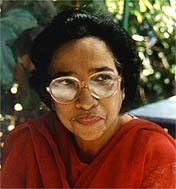
ANANDIBAI JOSHI – DOCTOR EXTRAORDINAIRE.

The Poughkeepsie Rural Cemetery overlooking the Hudson River in the heart of New York is a beautiful place to visit. Great men and women have been laid to rest in this tranquil atmosphere, with its artistically laid out gardens and monuments. Here in Lot 216-A stands an upright rectangular stone adjacent to the plot belonging to an old family – the Carpenters. It is simple and devoid of ornamentation, under which is interred the ashes of the first Indian female Hindu doctor, Dr. Anandibai Joshi, who received her medical education abroad. Why her ashes were transported from India to New York, is a story worth telling.

Born into a wealthy Brahmin family in Kalyan (near Bombay) on March 31st 1865, this little girl was married off at the age of nine, to a widower who was twenty years her senior. Gopal Rao Joshi was a postal clerk. But he was a progressive thinker who supported widow marriage and the education of women. Her name was promptly changed from Yamuna to Anandibai, and he made it his life’s vocation to educate her. He was transferred from Kalyan to Alibagh to Calcutta. He sent her to mission schools whenever possible, but took it on himself to teach her English. Gopal would take his young wife for long walks during which his teaching sessions continued. He was convinced that learning English was more important than learning Sanskrit. But Anandibai confessed that learning from her husband was not easy. He would hit her with pieces of wood or chairs or books. Later, in her correspondence with him from USA, she had the courage to complain against his tyranny.

“I had no recourse but to allow you to hit me with chairs, and bear it with equanimity.”

Anandibai delivered a child at fourteen. The boy lived for only ten days as both of them did not receive proper medical care, because the only doctor available was a Christian. This was the beginning of her ill-health. It made her determined to become a doctor so that she could help other Hindu women. In this, she was fully supported by her husband. Gopal wanted to send her abroad for medical studies, even though they had no money. But here was a woman who believed that whatever the circumstances, nothing or nobody could stand in the way of her achieving her dreams. Her determination coupled with her husband’s encouragement was the first step towards achievement.

Gopal wrote to a missionary friend Royal Wilder in the US, asking for help to admit Anandibai to a medical school, and also find a job for himself. The missionary was willing to help on one condition, that they convert to Christianity. This was unacceptable to the couple. However, Wilder was good enough to publish Gopal’s letter in the Princeton Missionary Review. A woman named Theodosia Carpenter was touched by the earnestness of the letter. She offered to accommodate Anandibai when she came to the US. She struck up a correspondence with the girl, and they became good friends through their epistolary exchanges. They discussed Hindu culture and religion. They exchanged views on early marriages and the effect this had on women’s health, of the status of women in society and various other women’s issues. Anandibai’s clarity of thought on such issues was very mature. She was a feminist and believed that she had a right to live and grow and follow her heart. Theodosia brought out the best in her.

But Anandibai’s health began to deteriorate. While in Calcutta she suffered from fever, breathlessness and general debility. The medicines that Theodosia sent did not do much good. Gopal however, was determined to send her to USA for her medical studies.

There was much opposition from the conservative Hindu community. They were insulted, ostracized and sometimes physically attacked. In a letter to Theodosia she wrote,

“My designs meet with approbation of a few, say one or two thousands. They are probably youth, reformists and patriots. I am not discouraged. I must not fear but show all, what Indian ladies are.”

Anandibai addressed the opponents in her community about the urgent need for female Hindu doctors. She talked convincingly about her son’s death and her own ill-health because there was no Hindu doctor to care for her. She also promised that she would never convert to Christianity. Her speech made an impact on the community. Donations began to pour in. Even the Viceroy made a donation of two hundred rupees.

So in June 1883 at the age of nineteen, a weak but determined Anandibai sailed to USA, chaperoned by two friends of Theodosia. She got admission to the first Women’s Medical Programme offered by the University of Pennsylvania. She even won a scholarship of $ 600/- for three years. Her dissertation was on “Obstetrics among the Hindu Aryans.”

Anandibai in her 9-yard Maharastrian sari must have been something of an oddity. With her arms and calves exposed, the cold was unbearable. In this weak state, she contracted Tuberculosis. But in spite of ill health, she persevered with her studies. She graduated on 11th March 1886. Her husband and a social reformer Pandita Ramabai were present at this function. Even Queen Victoria sent her a congratulatory message. The Philadelphia Post wrote, “Little Mrs. Joshee who graduated with high honours in her class, received quite an ovation.”

Anandibai sailed back to India on October 9, 1886, and received a rousing welcome on arrival. She was made physician in charge of the female ward in Albert Edward Hospital, Kohlapur. But her professional life was short lived. Illness claimed her on February 26th, 1887, at the early age of 22. Gopal sent her ashes back to USA to be laid to rest in Theodosia Carpenter’s family plot at the Poughkeepsie Cemetery.

Here was a brave child woman whose determination empowered her, but her frail body gave out prematurely. Her last words were “I did all that I could.”

Thursday, June 9, 2011

THE CLOUD MAIDENS OF SIGIRIYA


 Sigiriya is Sri Lanka’s most famous Lion Rock. From Kandy, it takes about two hours to reach there. The giant rock towering over the surrounding forests and looming into the skies at a height of 200 metres, can be seen from a distance.

In the 5th Century A.D. the rock resembled a recumbent lion with an artificial head built of bricks, resting on two enormous lion paws hewn out of the rock. Between these paws was a steep stairway that led to the magnificent palace of King Kassapa. Today, all that this left on the flat top are the ruins of this palace.

Sigiriya was later handed over to the Buddhist clergy, who used it as a monastery up till the 14th century. Then it fell into disuse until rediscovered by the British in the 19th Century.

The picturesque road leading to the base of the rock is through well laid out gardens, fountains, pools covered with lotuses and birds of bright plumage that dart in and out of the trees.

It is a long climb to the top over boulders linked by limestone stairs. Protective handrails make the ascent easier. But half way up, one encounters a fabulous sheltered gallery covered by rock paintings of beautiful sensuous women, reminiscent of the Ajanta frescoes in India. They are of graceful bare-breasted women with slender necks encased in dangling chains, narrow hips and coiffs decked with flowers. They seem to rise from the clouds in colours of red and gold, singly or in pairs, with expressions that reflect a variety of moods. These figures which are painted on the open surface of the rock were once more than 550 in number. Today, only 23 have survived the onslaught of time.

Beyond the fresco gallery, there are steps clinging to the sides of the rock. They are protected from the elements by a wall three metres high, which is glazed on the inside, and has retained its shine over the last 1000 years. It is called the Mirror Wall and graffiti scribbled on its surface describe the impressions of visitors about these gorgeous damsels painted in the gallery. Only about 685 of these have been deciphered. They are written in Singhalese or Tamil. But for those curious to know what they mean, English translations can be found in any tourist guide book.
“The ladies who wear golden chains on their breasts beckon me. As I have seen these ladies, heaven appears to me not so good.”

“Hail golden coloured one on the mountainside, whose resplendent rosy hand bore a blue water lily, bewitched my heart and tore it from another.”

One from a jealous female scribbler says, “A dew-eyed female from the mountainside arouses anger in my mind. In her hand she has taken a string of pearls and in her looks she has assumed rivalry of us.”

Who were these ‘cloud maidens’ of Sigiriya? Archeologists and historians have voiced their own views. Some suggested that they represent ‘Lightening’ and ‘Clouds.’ Others believe that they are ladies from King Kassapa’s court in a devotional procession to the shrine of Pidurangala. Some call them ‘apsaras’ and others say these are artistic depictions of court life and its expressions of royal shenanigans.

But as Sigiriya was used as a Buddhist monastery, the common belief is that these frescoes are representation of the Goddess Tara, who is worshipped in many centres of Mahayana Buddhism. She is a heavily jewelled deity who dresses in colours of red, yellow, green or blue and holds a water lily or lotus in her hand.

Whoever these frescoes depict and however old they may be, they cast a magic spell on viewers who climb the Sigiriya rock all the way to the top.

Thursday, March 10, 2011

BEATRIX POTTER – THE ENVIRONMENTALIST.


In summer, a trip to the Lake District is reviving. Wordsworth called it the place where ‘God and Nature commune.’ Its rolling hills and placid blue lakes under clouds tinted with empyrean light, give it an ‘other worldly’ ambience. Beatrix Potter author, illustrator and environmentalist lived here for most of her adult life. Though her books – Tales of Peter Rabbit, Tailor of Gloucester, Benjamin Bunny and other stories are now overshadowed by Harry Potter and his exciting antics, there was a time when children who read them were fascinated by her animal characters and even thought they lived with her, especially the much loved Peter Rabbit. People of the district thought of her as a neat and tidy ‘blue eyed bonny woman,’ just like her animal character Mrs. Twiggy Winkle.

Beatrix Potter was born on 28th July 1866, and spent the first 24 years of her life at 2, Bolton Place, London. She was tutored at home by governesses, in a claustrophobic school room on the top floor of her house. Her loneliness led her to create her own indoor animal farm by smuggling in her muffs and voluminous pockets, rabbits, mice and hedgehogs.

But for three months in summer every year, the family moved to Windermere in the Lake District, where she loved to roam over those green open spaces and breathe in the fresh air of the fells. Though Wray Castle where they stayed was a monstrosity, it overlooked the lakes and enjoyed the gentle refreshing breeze that blew inland.

The Reverend Drummond Rawnsley, Vicar of Windermere became her friend and guide, He showed keen interest in the animals which travelled with her in small cages or boxes, and encouraged her to make sketches of them or paint scenes from the countryside. He also stirred up in her a deep concern for preserving the natural beauty of the region. Her activities however were considerably hampered by an autocratic father and the responsibility of caring for her parents.

The royalties from her first book were used to purchase her beloved Hill Top Farm in Sawry. She could only make brief visits to the farm from London. But she used them well. John Cannon her tenant farmer taught her how to plant, hoe and use the farm implements. She also used this time to make sketches of houses, gardens, animals and the countryside, which she later incorporated into her books.

Beatrix’s obsession with preservation of the area in its natural splendour, prompted her to buy pieces of land and property when ever they came up for sale. This was to save them from demolition and commercial enterprise. Her only regret was that she could not spend enough time on her property, as her filial duties kept her in London for the better part of the year.

Beatrix was rescued from boredom and spinsterhood by William Heelis a solicitor, who belonged to the firm which managed her estates. Though her parents opposed her marriage, Bertram her brother argued that at 47, she had the right to marry whom she wanted.

Now she had more freedom to plunge into farming. She moved into larger quarters, and also worked tirelessly in the fields. Her one big obsession was to preserve the environment. She became an active member of Cannon Rawnsley’s National Trust. Acquiring property was not for any personal wealth but to prevent destruction of Nature by new constructions and tarred roads.

The villagers had no idea that she was an author, though her little books were on sale at the “Ginger and Pickles’ store in the village. To them she was an eccentric lady farmer, who wore rough clothes and stomped around in wooden clogs. Anyone who wanted to sell their property for shops, pubs and fancy houses, received a tongue lashing from her.

But she was generous to a fault with newly weds who couldn’t find accommodation or to widows who couldn’t support themselves. She even arranged for a district nurse to make herself available, and gave her a rent free cottage and a car. This was the beginning of the Hawkshead District Nursing Association. Her sympathy for those in need and her frugal life style endeared her to the people. When electricity came to the district in 1934, Beatrix preferred to stay with oil lamps and candles.

Beatrix died on December 22nd, 1943 at the age of 72. She bequeathed her extensive property to the National Trust of Lake District. Her shepherd of twenty years Tom Storey scattered her ashes on the Hill Top pastures, where her presence hovers benevolently over the quiet dales.

Beatrix’s books and personal effects are exhibited at Hill Top Farm. At the Beatrix Potter Gallery in Hawkshead, one can see her original drawings, story books and some of her endearing animal characters. Her whole life was devoted to green cause of the ‘most pleasant countryside in the world.’


Wednesday, January 5, 2011

SELMA LAGERLOF - FIRST FEMALE NOBEL LAUREATE

Varmland in western Sweden is not on the usual tourist itinerary. Yet this is a beautiful region extending towards the Norwegian frontier. Driving through this quiet scenic countryside, its green rolling planes, its serene uplands and its placid lakes, makes a traveler feel one with nature. History records that Christianity spread from Norway to Sweden via Varmland.

The little town of Marbacka in this region was the home of Selma Lagerlof, a Swedish author. She was the first woman to receive the Nobel Prize for Literature.

Born on November 26th 1858 at Oster Emterwick, she grew up in Marbacka. Folklore, legends and traditions of this area became an inseparable part of her life. After her father’s illness, the family home had to be sold. Selma was loath to move away, and as soon as she could afford to, she bought it back and lived there till her death. In her book “The Story of the Manor” which was published in 1922, she describes this home at length.

Today Marbacka Manor belongs to a Foundation and is open to visitors in summer. As one wanders through those rooms and looks through her memorabilia, it is easy to visualize her life and times.

Selma was a teacher. She trained at the reputed Teachers’ Training College in Stockholm. She worked as a teacher for ten years. Though she started writing poetry at an early age, she did not get into print until 1890. Her novel Gosta Berlings Saga received wide acclaim especially after it was translated into Danish in 1891. It was the story of a clergyman who was dismissed from his job for his drunkenness.

This novel was followed by Osynliga Lanker (Invisible Links) in 1894. With her success, she decided to quit teaching and become a full time writer. It helped that the Royal family and the Swedish Academy offered to support her financially. She could also afford to travel extensively and visited Italy, Greece, Egypt and Palestine. She used some of these places as backdrops to her stories. Some were romantic; others were religious or touched on the supernatural. In Sicily, she saw a statue of Jesus which seemed more like a caricature of him. It prompted her to write “Miracles of the Antichrist” in 1897. One cannot ignore the blending of social and moral values in her writing.

In 1894, Selma became a friend of Sophie Elkan, another writer. They were fast friends till the end of her life. From their correspondence it was assumed that theirs was a homosexual relationship. Sophie showed signs of jealousy when Selma grew friendly with Valborg Ohlander, who was also her literary agent.

Selma’s knowledge of legends and folklore made her a good writer of children’s stories too. “The Wonderful World of Nils” became a children’s classic.

In 1900, Selma travelled to Jerusalem. This visit inspired her to write her major work “Jerusalem” in two volumes. It was a novel about Swedish peasants who migrated to the Holy Land.

By now the world had recognized her as an excellent writer. In 1904, the Swedish Academy presented her with a gold medal. In 1907, she was awarded the Nobel Prize for Literature for her voluminous body of work. She was the first woman to be so honoured.

Selma died in her Manor on March 16th 1940, at the ripe old age of 82. Marbacke’s famous author was buried in the churchyard of Ostra Amterwick, about four miles away for her home.

Monday, October 11, 2010

ABBAKKA MAHADEVI – THE WARRIOR QUEEN.(1540-1625)

On the west coast of India about 8-10 kms from the port city Mangalore, is a small town called Ullal. Situated on the south bank of the Nethravathy River, it has a scenic coastline along the Arabian Sea. Huge black rocks and treacherous breakers make some parts of the beach unsafe for swimming. But the shady stretches of causarina groves and miles of golden sand make it an ideal place for a holiday.

Way back in the 16th century, Ullal was a small port exporting spices and black pepper. Being a rich and popular trading centre, it was coveted by the Portuguese, British and Dutch. But for almost four decades a young queen called Abbakka, successfully repulsed these intruders, making them beat a hasty retreat. Her main enemy was the Portuguese who tried to capture Ullal on many occasions between 1558 and 1618, by land and by sea. Abbakka had a well trained army drawn from all castes and religions. The Mogaveeras (fisher folk) were sturdy and fearless men who formed the backbone of her army.

In 1568, Portuguese General Joao Peixoto managed to enter her royal court with his men. But Abbakka fled and took shelter in a mosque close by. Here she banded together 200 of her best soldiers and went back to face the enemy. Peixoto and several of his men were killed, and many others taken captive.

Abbakka belonged to the Chowta Dynasty which ruled a part of South Kanara, from the temple town of Moodabidri to Ullal. She had a dusky complexion with sharp attractive features, and though short, carried herself with great dignity. The Chowtas followed the matrilineal system of inheritance. So female members became leaders. Abbakka’s uncle Tirumala Raya trained her in warfare, sword fighting and archery. She was supposed to be the last person who used the fire arrow (Agni Vana) in warfare. She was also an accomplished horse rider.

Tirumala Raya trained her to be a good administrator and business woman. At the age of 15, he made her the Queen of Ullal. But her marriage alliance with Lakkaya the Banga Prince of Mangalore, was disastrous. He was a lackey of the Portuguese, and willingly paid taxes to them hoping to remain in their favour. Abbakka refused to be subservient or to pay taxes to a foreign power. She spurned their terms of trade and preferred to ship commodities directly to the Middle East. Her attitude caused much friction between the couple and she separated from him, returning to Ullal to resume her royal duties.

Even though Abbakka was a queen, she was very simple and always dressed in a cotton sari, with a cloth covering her mouth and upper torso. Her umbrella was made of areca palms. She was also a caring queen who had the best interests of her subjects at heart. She dispensed justice to her people, often working late into the nights.

Abbakka was an astute statesman. She forged alliances with the Zamorin of Calicut, the Sultan of Bijapur Ahmed Nazar, and several Muslim chieftains. Her last war against the Portuguese was in 1618. In the war, she was represented by a General from the Zamorin’s army. Though he was able to capture the Mangalore Fort, he was killed on his way back to Ullal. Abbakka was arrested and jailed soon after. But she revolted and died fighting. She was the first female freedom fighter of India against Colonial powers.

Abbakka belonged to the Jain sect which is so non-violent that it prohibits killing even of an insect. But she had no qualms about vanquishing her enemies through warfare.

After one of the Portuguese defeats, the Emperor of Spain reprimanded his Portuguese commander,
“Are you not ashamed of being defeated again by a black, dwarfish Indian woman named Abbakka? Though she is our enemy, I have great admiration for this heroic woman. Tell me something about her.”

It was the Persian Emperor Shiya Abbas who advised Peitro Della Valle an Italian traveller, to interview Abbakka. “When you go to India, please go to Mangalore without fail. There is a pepper queen named Abbakka, who is the talk of Europe for her victories over the Portuguese. Don’t miss to meet that woman.”

Yet in her own country she was forgotten for centuries, and only remembered in folklore and field dramas. Of late, there has been a resurgence of interest in her. In 2003, the Postal Department issued a stamp to honour her. Bronze statues have been erected in Bangalore and Ullal. There she sits in all her splendour astride a horse, mounted on a high platform at the Abbakka Devi Circle.

Since 1998, the Veera Rani Abbakka Utsava is held annually, when distinguished women are honoured. There is talk of a film on her life in the making.

Visitors to Ullal can see the Somanatheshwar Temple built by the Queen and the remains of her Fort in the vicinity of the temple. The Rudra Rocks (Rudra Shila) close by, is a sight to behold, as it keeps changing colour because of the relentless pounding of the waves. Ullal is well connected by road or train, and a lovely weekend get-away.

Wednesday, August 25, 2010

SISTERHOOD OF RED AND PURPLE.

The Tulip Festival in May 2006 at Orange City Iowa, was a crowd puller. Here, 19th century Holland was brought to life by people of Dutch origin, through floats, tableaux, music and plenty of Dutch food. It was a pleasure to watch people dressed in period costumes with wooden clogs and bonnets, representing different areas of Holland.

I saw a motley group of middle aged women wearing red hats and purple dresses, in a glaring mismatch of colours. I presumed that this was all a part of the festival, and that these women would probably be part of the parade. They seemed a friendly lot. So I moved closer, and struck up a conversation.

“Which part of the Netherlands do you come from?”

They guffawed.

“Oh dearie,” one of them said, “We’re all from Iowa. We’ve just come here to have some fun.”

“But the garish costumes?”

“You must be new to the country. Haven’t you heard of the Red Hatters in their red hats and purple dresses?”

“No,” I said, “But perhaps you could fill me in.”

And so over tea and Dutch cookies, I heard about this inspiring social group of women above fifty years of age, who meet every month to talk, laugh, eat and enjoy themselves.”

“What do you do?” I asked.

“Nothing. We just have fun. But it’s more than that. You could call it a Fellowship. We share a deep bond of affection forged by our life experiences, and we do have a zest for living.”

Sometime in the mid-nineties, a woman named Sue Ellen Cooper, who lives in Fullerton California, went on a holiday to Tuscon. She bought a bright red hat at a thrift shop, which she thought looked cute. A couple of years later, she happened to read a poem called “Warning” by a British writer called Jenny Joseph, which was about purple dresses and red hats.

An idea struck her, and on her friend Linda Murphy’s 55th birthday, she presented her with the red hat and a copy of the poem. It was well appreciated, and Linda in turn, bought a similar gift for another friend. And so it spread to a group of five women who possessed red hats. To complete the poem’s image, they all bought purple dresses and went out to tea in their eye catching costumes. On April 25th 1998, the Red Hatters’ Society was born in Fullerton California, with five members.

Then one of them sent a red hat as a gift to her friend in Florida. It was the beginning of a sibling group there. Today there are 40,000 chapters in 30 foreign countries all over the world. Each chapter has about 20-25 members.

Their motto is “Red Hats Matter.” They have also adapted Mike Marline’s music as their theme song.

“All my life I’ve given to you,

Now it’s my turn to do for me.”

Most women dread facing middle age. Not these Red hatters. They come from all walks of life – grandmothers, golfers, teachers, entertainers and housewives. Their spirit of buoyancy is infective. They call themselves a ‘disorganisation’ with no rules or by-laws. This makes them adventurous, ready to try out new things, or even change the course of their lives.

Ageing is something to be welcomed with enthusiasm, and not to be anticipated with fear. They have no time for gloomy, morose people who stifle the joy of living. The vibrant colours they wear are liberating.

This particular group in Iowa has taken up a new interest. They are the Red Hat Quilters. At their meetings, the hostess passes out a large square of fabric coloured red or purple, to each member. Each must make a quilted block out of it. When sufficient blocks are made, a lucky winner is given all the blocks, to make a quilt for herself.

Each chapter has its own activity. For those below fifty who would like to join, the colour schemes are different. They have pink hats and lilac dresses. April 25th is celebrated as the Red Hat Society Day.

Just interacting with this group made me feel twenty years younger. I wonder if there are any similar groups in other copuntries. Such lively groups would change the mind set of many middle aged women, who feel lonely and unwanted.

Friday, June 11, 2010

CHARLOTTE CORDAY- ANGEL OF ASSASSINATION

.On my travel to France, the beaches of Normandy beckoned. It is just 10 kms from the English Channel and is famous for the Battle of Normandy during WW II, when the British and Allied forces invaded France by land, sea and air, and captured the town of Caen on 9th July 1944. Today, Caen is totally urbanized, and is the capital of lower Normandy.

Caen brought to mind the story of Charlotte Corday, a woman posthumously nicknamed
“Angel of Assassination,” by the painter Alphonse de Lamartine. She was born into an aristocratic family in Orne, Normandy. As she lost her mother early in life, she was sent off to the Holy Trinity Convent in Caen along with her sister, because her father Jacques Francois de Corday could not cope with their care.

Charlotte had a fine education at the convent. She had access to a well stocked library, where she became acquainted with the life and works of Plutarch, Voltaire, Rousseau and others. This might have influenced her political views in later life. After her education, she stayed with a rich cousin and eventually inherited her estates.

Charlotte approved of the French Revolution and supported the Gerondists, a loose group belonging to the Jacobin Club. She called herself a ‘conservative Gerondist.’ This group consisted of lawyers, journalists, and various professionals who shared a common ideology and also nurtured political ambitions. They considered themselves ‘elite’ and were totally out of touch with the needs of the common people.

Among this radical group was a journalist called Jean Paul Marat. Through his articles and newspaper, he incited people to violence. He even had twenty two of his own fellow Gerondists arrested. The irony of it was that he wrote his dangerous missives from a bath tub in which he was perpetually immersed, because of an intractable skin disease.

Charlotte became disillusioned by the group, and held Marat responsible for the September Massacre. He was also indirectly responsible for the execution of Louis XVI. In 1793, when fellow Girondist Jacques Pierre Brissot denounced Marat openly, she decided that something had to be done about it. She hated violence and bloodshed and was afraid that Marat would start a civil war against the Republic.
“I will stop him and end all this violence,” she vowed, “He is nothing but a heartless rabble rouser.”

In July 1793, Charlotte left for Paris with a copy of Plutarch’s “Parallel Lives,” and checked into Hotel de Providence. Then she wrote out her message to the people of France, about the necessity of eliminating Marat. Armed with a kitchen knife having a sharp six inch blade, she set out for Marat’s house. She was denied entry even though she claimed that she had reliable information about a Girondist uprising in Caen.

Undeterred, Charlotte returned that evening. This time she was allowed entry. As usual, Marat lay soaking in his bath tub. Charlotte approached with a list of some Gerondist names. As he took the paper from her, she plunged her knife into his heart. But she least expected that this would make him a martyr.

At her trial Charlotte proudly announced, “I killed one man to save 100,000 lives.”
But the Tribunal would not allow her to be revered for her political idealism. They declared her insane, and four days later, on the 17th of July, 1793, she was guillotined.
As an insult, her decapitated head was slapped by a man called Legros. Legend has it that Charlotte turned her indignant eyes at him and bored into his soul. The man was imprisoned three months later for this act.

But Charlotte was not to be forgotten. Two years later, she was hailed as a heroine who sacrificed her life to kill a monster.
She has been immortalized by poets like Shelley and painters like Alphonse de Lamartine.
An Italian composer even wrote a three-act opera about her, which was staged in Rome in 1989. Her life reminds me of what Shakespeare said, “Cowards die many times before their death; the valiant taste of death but once.”