Wednesday, July 29, 2020

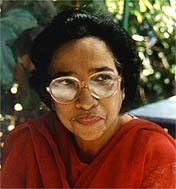
KESAR DEVI SETHIA – THE FACE OF COURAGE.


Kesar Devi Sethia of Sujangarh was a woman of extraordinary courage and compassion. During the partition of India, when violence flared up in her little town of Sujangarh, she bravely averted a Hindu-Muslim riot that might have resulted in a massacre of Bisayathi Muslims. Her story was brought to light by her grandson Umrao Singh Sethia, who learnt of her bravery directly from the lady herself.
Kesar Devi belonged to the influential Baid family of Ladnun, whose forefathers were hereditary Dewans of the State of Cooch Bihar. Like the male members of her family, she was trained in martial arts, horse riding and other outdoor sports.
She was married off at an early age to Srimant L.C.Sethia, a member of the Advisory Council of Maharaja Sardul Singh of Bikaner. During the reign of Akbar the Great, Srimant Sethia’s ancestors were bestowed the title of ‘Sethia.’ The family was always close to the seat of power and so enjoyed de facto status of a local ruler. Tragically Srimant Sethia died at the early age of 32 years, leaving Kesar Devi to involve herself in the welfare of the people of Sujangarh.
Sujangarh is about 150 kilometers from Bikaner. In those days the population of the town was about 30,000. It was a peaceful town famous for its havelis, temples and ancient forts. People of all sects and religions lived in perfect harmony for generations.  About 30% of the population were Muslims and belonged to different communities like the Bisayathis, Mohils, Chippas and others. They occupied the eastern and southern parts of the town and were mostly labourers, hawkers and petty traders.
The Bisayathi Muslims were a peace loving community who lived on the northern side of the Sethia Mahal. Some of them were employed in the gardens and stables of the Mahal. Kesar Devi was known for her kindness and generosity to deserving people and felt responsible for their welfare. She was looked upon with respect and reverence and was popularly referred to as Maaji Saheb.
In 1947, when the partition of India took place, the line of partition ran through Sujangarh. A small part of the town went to Pakistan. Even though Maharajah Sardul Singh had assured the Muslims of safety and protection, some of them opted to go to Pakistan.
Simultaneously, there was an influx of Hindu refugees from Sindh, who came with frightening stories of brutality and murder of Hindus in Pakistan. For a while there was calm in Sujangarh. But as the Sindhi population grew, the local Hindus were influenced by their stories of gory atrocities. Together they planned to attack the Muslims and get rid of them. As the Bisayathis were a quiet people, they were the first group to be attacked. Their houses were torched and many lost their lives.
Kesar Devi was woken up one night by shouts and screams of people crying “Bachao, Bachao.” From her window she saw flames of fire spreading through the Bisayathi ghetto. Men, women and children both old and young were frantically running towards the Mahal, which was their only hope of refuge from their attackers. Some had already reached the gates and were crying out for protection.
Maaji Saheb rushed down towards the gates and ordered the security guards who were poised to shoot, to lower their arms.
“Open the gates at once,” she shouted, “Let the people in.”
“But this is a dangerous crowd,” they protested.
“At once,” she shouted.
The frightened Bisayathis rushed into the compound. Then the gates were firmly closed.
There were about 150 of them. Maaji Saheb ordered her staff to herd them into the underground store rooms of the Mahal where they would be safe.
            A few minutes later, the menacing attackers arrived with sticks, staves and burning torches.
“Open the gates before we break them down,” they shouted, “Send out those people you are hiding in your compound.”
Maaji Saheb stood there like Goddess Durga, an unleashed sword in her right hand.
“Get out – Go home at once. These Bisayathis are like my own children. I will see that no harm comes to them.”
But the crowd shouted louder. “We will break down the gates if you don’t send them out at once. We will rid Sujangarh of everyone of their tribe.”
Now Maaji Sahib was furious. “If you don’t disperse within ten minutes, I will ask my guards to shoot all of you. You will drown in your own blood.”
The anger reflected in her eyes showed that she meant what she said. Turning to the guards she ordered, “Just 10 minutes. After that you must shoot them all down.”
The crowd quickly dispersed, but Maaji Saheb stood at the gates all night to make sure that they did not return.
            The Bisayathis enjoyed her hospitality for over a month. They had food, clothing and shelter. They were even given money and assistance to rebuild their homes.
            The local authorities rounded up the trouble makers and sent them to prison. The refugees from Sindh were warned that if they continued to stir up trouble, they would be sent back to Pakistan.
            Ever since then, Sujangarh has remained an oasis of peace. The population of the town today is about 1.5 lakhs. As a sign of gratitude to the lady, the Bisayathis came to the Mahal at every Eid to receive her blessings.  At Muharram, they brought the Tazia to the gates of the Mahal as a sign of respect. Though Maaji Sahib died in 1965, the Bisayathis still continue the practice.

Friday, June 19, 2020

ISLON - RANI OF NANCOWRY.


            Nancowry is a group of islands in the middle of the Nicobar Archipelago. Islon an illiterate tribal woman from this region improved her social status by marrying a Tahshildar of Nancowry who acted as a British administrator. He was a generous man who helped his tribal wife to command respect from her fellow-Nicobarese. When disputes were brought before him, he referred them to Islon to settle, conferring on her the dignity of a magistrate. In time Islon grew in importance and became a British agent in Nicobar.
            In 1914, the German cruiser Emden struck terror in the heart of the British Empire. The cruiser commanded by Karl Freiderich Max von Muller would sneak into Indian waters and raid British ships plying on busy trade routes. The cruiser was called the ‘swan of the East.’ One of its funnels was camouflaged to look like a British ship. In two months the German cruiser had intercepted 23 merchant and naval ships and destroyed 74000 tonnes of goods.
            In October 1914, the Emden sailed to the Nicobar Islands. Islon mistook it for a British ship and hoisted the Union Jack to welcome the ship. Commander Muller was fooled into thinking there was a strong British presence in the islands, and hastily withdrew and sailed off to Penang. Islon soon realised this was a German ship. She immediately dispatched a messenger to the nearest signal station to tip off the British, who were able to capture the elusive ship with its commander and crew. Islon’s information led to the capture of Emden, and Muller remained as a prisoner of war in England until the end of the war in 1918.
            The grateful British conferred on Islon the title “Rani of Nancowry.” She lived with her family in three buildings which came to be known as the Rani Ghat (Queen’s Palace.) Her contact with the British ended in 1945.But Islon continued to remain an important person even after Indian Independence. She was the link between the Nicobarese and the newly independent India. She continued to head her unique political institution and appointed her brother Ramakrishna as her Chief Captain. Even the Japanese held Islon and her brother in great respect.
            Rani Islon died in 1954, and her daughter Lachmi became the next Rani. She ushered in a period of economic prosperity. The people of Nancowry started a regular trade with merchants in South East Asia. Lachmi died in 1989 and was succeeded by her daughter Fatima. But the tsunami washed away this small peaceful world.
            Rani Islon was one of the tallest leaders of the Nicobarese. But belonging to a historically isolated community not much is known about her life.

Wednesday, January 29, 2020

EMILY HALE - HER ENIGMATIC LOVE LIFE.


            A sudden interest in the life of the American Drama teacher Emily Hale has cropped up,
with the opening of her cache of 1131 love letters, fifty years after her death. These letters had been deposited in the Princeton University Library in 1956, and was opened in January 2020, in accordance with her wishes. The letters will be of interest because they will reveal the secret love life of a woman, who was not just the muse of the poet T.S. Eliot, but also his lover and confidante.
            Emily Hale was born on October 27th 1891, in New Jersey, to Reverend Edward Hale a Unitarian minister and his wife. But she was brought up by her aunt Edith Perkins and her uncle Reverend John Carrol Perkins in Boston. She attended Berkley Street School in Cambridge and Miss Porter’s School in Farmington, Connecticut, but did not go to college. She became a Speech and Drama teacher and worked in many universities in the US. Emily always wanted to be an actor but was prevented from doing so by her conservative aunt and uncle. She became a member of the Amateur Cambridge Theatre and took part in many plays that were well received.
            Emily first met T.S. Eliot the poet in 1912, at his cousin’s house. He was then doing a course in Philosophy at Harvard. In 1913, the Amateur Theatre group produced a scene from Jane Austen’s ‘Emma’ in which Emily and Eliot performed. Eliot seemed to have fallen in love with this slim, graceful girl with a smiling face, and he professed his love for her before he returned to England in 1914. However, in spite of his confession of love for Emily, he went back and got married to a girl called Vivienne Haigh-Wood.
            In 1932-1933, Eliot visited Emily and decided to seek separation from his wife on grounds of sexual incompatibility. He could not divorce her because he was of the Anglican faith. Vivienne became mentally ill and had to be admitted to a mental hospital, where she died in 1947.
            Emily spent her summers with her uncle and aunt at Campden, Gloucestershire between the years 1935-1939. During these visits, her friendship with Eliot was revived and they spent many hours together. In 1935, he even wrote a poem ‘Burnt Norton’ named after a home in England which they had visited. He said it was his love poem to her. This was the first of many poems he wrote, declaring that Emily was his muse. It was the beginning of their epistolary romance which saw many letters exchanged between them. But the contents of her letters to Eliot were never known as he burnt them all. Emily preserved each one carefully, secretly exulting in the love he professed. Their correspondence lasted from 1930-1956.
            If Emily hoped that Eliot would marry her after Vivienne’s death, she was sorely disappointed. Many of his friends thought she was too prim and boring. She had to settle for platonic love in their relationship. Eliot’s last letter to her was in 1956.
            But when Eliot married his secretary Valerie Fletcher, thirty years his junior in 1957, Emily could bear it no more. She came to know of it through a mention in the Boston Globe. She had a nervous breakdown and had to undergo therapy. Some wise man had cautioned “Never date a poet. He’ll always do a dirty on you,” and that is what happened. Was it Emily’s lack of self love and self esteem that permitted Eliot to ride roughshod over her emotions? In the end Eliot had the gall to say “Emily would have killed the poet in me.” He died in 1965.
            In time, Emily snapped out of her ‘Broken Heart syndrome’ with surprising resilience. She began to work again and continued to teach at the Abbot Academy of Drama from 1947- 1959.
            Emily led a quiet life after her retirement until her death on October 12th 1969. Unworthy as he was, she kept a photo of Eliot on the bureau in her apartment. Though her life was nothing but emotional chaos, she never bared her heart to the world. Now that those letters from Eliot are open to scrutiny, the literary world will have more details of that ambiguous relationship. As Anthony Curd an Eliot scholar said, “This is perhaps the literary event of the decade. I don’t know anything more awaited or significant. It is momentous to have these letters come out.”


Wednesday, September 11, 2019

ANNA MARY ROBERTSON MOSES -THE GERIATRIC WONDER.


            Anna Mary Robertson a folk artist of the 20th Century proved that Age is no bar to living a fruitful life. As Longfellow said “Nothing is too late until the tired heart ceases to palpitate.”
            Anna was born on 7th September, 1860, at Greenwich, New York. Her father was a small-time farmer, and she was third daughter in a family of ten. Her father recognized her passion for Art and would buy for her white paper sheets for her drawings. She would use lemon and grape fruit juice, grass, flour paste or saw dust to colour her drawings. Anna attended school for just a short time.
            At the age of 12, she became house keeper of a family and worked there for fifteen years. Her employers too recognized her interest in Art and provided her with chalk, wax and crayons. Apart from cooking and cleaning, Anna also did sewing and embroidery. She embroidered colourful landscapes on cloth and attractive quilted objects for family and friends, from 1930 till her 76th year when she began to develop arthritis. Using needle and thread for her embroidery became painful. Her sister suggested that painting would be easier.
            So in 1918 at the age of 78, Anna started painting every day until she was 90. When her right hand grew tired, she would paint with her left hand, but never gave up. She generated more than 1500 canvases and initially sold them for a pittance.
            In 1938, an Art collector Louis J Calder discovered her paintings in the window of a drug store in Hoosick Falls, New York. He bought all of them and promoted her work among New York Art dealers. In 1939, three of her paintings were exhibited in the New York Museum of Modern Art, titled “Contemporary Unknown Painters.”
This was followed by solo exhibitions in New York, other parts of USA and later in Europe for the next twenty years. Bennington Museum in Vermont has the largest collection of her paintings.
            In 1887, Anna was married at the age of 27, to Thomas Solomon Moses a farmer. They stayed in Virginia for two decades and had ten children. But only five survived. Always an industrious woman, Anna not only worked on the farm but supplemented their income by making and selling potato chips and butter churned from cows’ milk. In 1905, the couple relocated to Eagle Bridge, New York. Thomas died in 1927. Anna continued to run the farm with the help of her son Forrest.
            Anna portrayed pastoral scenes in different seasons, like snow fall in winter or budding greenery in spring. She also painted people engaged in farm activities. She was completely self- taught and developed her own style of painting from top to down- first the sky, then the hills down to houses, people and cattle. The luminous colours she used imbued her paintings with life. Artists may have thought her art was primitive and called it “Naïve Art,” but it never bothered her. “I paint to keep busy and pass the time away,” she said. She drew from memory.
A German critic remarked, “The unrest and neurotic insecurity of present day make us inclined to enjoy the simple, and affirmative outlook of Grandma Moses. She depicted the world as beautiful and good.”
Judith Stein an Art historian said she was ‘a cultural icon. The spry, productive nonagenarian was continually cited as an inspiration to house wives, widows and retirees.’
Jean McMahon, Professor of Women’s Studies called her a ‘homespun feminist who advocated Women’s Suffrage.’
Grandma Moses escaped from the feeling of domestic confinement through Art and her paintings.
            In 1950, the National Press Club cited her as one of the five most newsworthy women.
At 88 years, Mademoiselle Magazine called her ‘The Youngest Woman of the Year.’
            After retirement from farm work Anna moved in with her daughter. In 1952, she published her autobiography “My Life History.” She wrote “I look on my life as a good day’s work………Life is what we make it. Always has been, always will be.”
            The ‘tiny, lively woman with mischievous grey eyes and quick wit’ won numerous awards and two honorary doctorate degrees.
Her 100th birthday was celebrated as “Grandma Moses Day” by Nelson Rockefeller. In the September 19th, 1960 issue of Life Magazine, Grandma Moses was featured on the cover page.
She died at the age of 101, on December 1st, 1961, at a healthcare centre in Hoosick Falls, New York, and was buried in Maple Grove Cemetery.
President John Kennedy said, “Death of Grandma Moses removed a beloved figure from American life. The directness and vividness of her paintings restored a primitive freshness to our perception of American life.”
            Grandma Moses leaves behind the message that Age is no bar to a productive life.


Monday, May 13, 2019

AGNES SMEDLEY – SELFLESS POLITICAL ACTIVIST.


            Agnes Smedley was a radical activist from an early age. Most of her life was spent championing the cause of the oppressed. She held extreme political views which got her into trouble with the authorities.
            Born in Osgood, Missouri on February 23rd 1892, she was the daughter of a labourer Charles Smedley, who deserted the family when Agnes was 14. As her mother was sickly, Agnes was forced to work as a domestic, to help support her family. Undeterred by her circumstances, she passed the New Mexico Teachers Examination, and began to work as a teacher at the age of 16, in Terico.
            In 1911 Agnes joined the Tempe College. It was here that she became involved in student politics. She married her college mate Ernest Brunden in 1912, and moved to Teachers College in San Diego. In 1916, she joined the Socialist Party of America and was dismissed from college for her socialist beliefs.
            Agnes got divorced in 1917 and moved to New York. She joined a group of Indian students who were supporting their country’s Nationalist Movement against British rule. She joined the “Friends of Freedom for India” an organization which was closely monitored by the US government. Emma Goldman called Agnes a true rebel who seemed to have no other interest in life except the cause of the oppressed in India. She was also disseminating information about Birth Control under the influence of Margaret Sanger, a subject which was taboo at that time. In 1918, she was charged on these two accounts and sent to prison.
            After her release from prison, Agnes began writing articles for the New York Call and for a British birth control journal run by Margaret Sanger.
            Agnes moved to Berlin in 1920, with the revolutionary Indian leader Virendranath Chattopadyaya. It was a turbulent relationship with a man who had ‘a tongue like a razor and a brain like hell on fire.’ She felt she was living on the brink of a volcanic crater. While in Berlin, she opened the first Birth Control Clinic.
            In 1921, Agnes moved to Russia and got interested in the communist ideology. She was disillusioned by the lack of freedom of the people and felt that everybody was under surveillance. In 1928 she moved out of Russia and went to China. When in China, she spent a great deal of time with communist forces. She wrote articles for the Manchester Guardian and Chinese Review about the situation in China. She was aware of the misery and starvation of peasants and the overworked coolies. Agnes was instrumental in ensuring American support to the Chinese communists, to prevent the Japanese advancing in the Pacific.
            It was here in 1928 that Agnes wrote her autobiographical novel “Daughter of the Earth.” The book was published in USA and Germany and received good reviews. It was described as ‘America’s first feminist proletarian novel.’
            In 1941, Agnes went back to the USA. She continued with her writing and went on lecture tours describing life in China. She also lectured on world politics. She was dubbed a communist spy, who worked as a triple agent for the Soviets, China and India. The FBI monitored her speeches, as she frequently attacked the US government for siding with totalitarian regimes.
            In 1949, Agnes was fed up of the smear campaigns unleashed against her in the US. So she moved to Oxford, England. By then she was in poor health and she died at the age of 58, on 6th May 1950.
            Agnes Smedley was a complicated person. She acted out of humane motives, without considering the repercussions of her actions. She lived a life of extraordinary achievements as a gifted writer, a journalist and a feminist who had friends like Margaret Sanger, Emma Goldman and even Mao Tse Tung. But her enemies outnumbered her friends because of her political activism. Freda Utley described her as “one of the great people with burning sympathy for the misery and wrongs of mankind.”

Monday, March 18, 2019

KRIPABAI SATTIYANANDAN – INDIA’S FIRST FEMINIST WRITER.


In the 1880s, a young woman from Madras raised her voice against the systemic degradation of women. She believed that if women had to rise to power, they should redefine feminity. Marriage and domesticity should not be the sole ambition of women. They had the right to live and not simply exist; the right to independent thought and intellectual pursuits. This brave woman was bold enough to communicate her convictions through her writing. She was the first Indian woman to write in English, and the first Indian feminist novelist.
Kripabai was born in 1862 at Ahmednagar, to Hindu parents Haripunt and Radhika Khisty. She lost her father at an early age and was brought up by her mother and brother. Her brother Bhaskar encouraged her to read a lot, and engaged her in discussions on then prevailing issues. Unfortunately he too died at a young age.
Kripabai converted to Christianity but she grew up observing both religions. Her education was sponsored by two European missionaries. She was the first woman to attend the Madras Medical College. She lived as a boarder in the house of Rev. W. T. Sattiyanandan. But because of her poor health, she had to discontinue her medical studies.
While boarding in the Reverend’s house, she fell in love with his son Samuel Sattiyanandan and married him. He was the Head Master of a school in Ooty. Kripabai used that time in Ooty to start a school for Muslim girls. She was a strong advocate of women’s education This was also the time when she started writing her articles and poems. They were published under the byline “An Indian Lady.” Her first published article was “A Visit to the Todas.”
Ill health dogged her footsteps and she had to return to the warmer climate of Madras in 1886, when she seriously began to write her first book “Suguna –Story of a Native’s Christian Life.” It was semi-autobiographical in which she also referred to her brother. Though she spoke Marathi, Tamil and Telugu, she found it easier to write in English in which she was fluent. During this time, she gave birth to a child who died before its first year.
Kripabai’s health gradually deteriorated. She was diagnosed with Tuberculosis which did not respond to treatment. She used this time to write her second novel “Kamala”- The story of a high caste Hindu woman caught in the grip of orthodoxy, and her life as a child bride, mother and widow. Some of it was written from her hospital bed.
Kripabai was an advocate of women’s education. She was passionately involved in women’s issues and decried decadent customs and superstitions. Some of her articles were unfinished at the time of her death in 1894.
Madras Medical College has perpetuated her memory by offering a scholarship to a woman candidate to study Pharmacology or go for higher Medical studies. Madras University too offers a medal to a female who stands first in English.
It is a pity that Kripabai died so young and could not see the progress of women in the 21st century.
           

Saturday, September 8, 2018

VICTORIA WOODHULL – A SOCIALLY SCANDALOUS ACTIVIST.


             Victoria Woodhull lived by her own rules and was a radical in many ways during her life time. She donned many hats as publisher, author, women’s rights activist and politician. She was hailed by some, scoffed at by others and disparaged by many. Yet she succeeded in leaving her footprints on the sands of Time.
            Born in Ohio, USA on 23rd September 1838, to an illiterate mother and a petty criminal father, Victoria had never been to school until she was eight, and then on and off for three years. She was forced by her father to become an itinerant clairvoyant along with the sister Tennessee, telling people’s fortunes and acting as a medium for contacting spirits. It brought in some money for their sustenance. But much later in life she gave up spiritualism and even derided spiritualist frauds.
            Victoria had many firsts to her credit. In 1868, along with her sister Tennessee, she became the first woman to run a Stock Brokerage Company on Wall Street, courtesy the wealthy industrialist Cornelius Vanderbilt to whom she provided ‘psychological solace.’ But being a woman, she could not get a seat in the New York Stock Exchange.
            In 1870 she published the “Woodhull and Claflin’s Weekly” and ran it for six years. In this paper she freely expressed her controversial opinions on social reform, women’s suffrage, birth control, and taboo subjects like free love and sexuality. Her paper was the first to print an English translation of the Communist Manifesto by Karl Marx and Frederich Engels.
            In 1871 through the influence of her friend Benjamin Butler a senator of Massachusetts, she became the first woman to address a Congressional Committee in the House of Representatives, on Women’s Rights. She said, “Women are the equal of men before the Law and have equal rights.” This brought her popularity and a position of leadership among the suffragettes. But a few years later, many of them became her fiercest critics, fearing that her unconventional lifestyle would put the Movement in jeopardy. When a comprehensive History of Women’s Suffrage was complied, her name was never mentioned.
            Victoria will go down in history as the first woman who ran for President of the United States in 1872. By then she had formed her own “Equal Rights Party” and contested on its ticket. But she was below 35 years of age which was the constitutionally mandated age for all candidates. No one took her candidacy seriously and she received no electoral votes.
            Victoria was also an author. Among her publications were “Stirpiculture or the Scientific Propagation of the Human Race” (1888) “Garden of Eden: Allegoric Meaning Revealed” (1889) and “The Human Body – The Temple of God.”(1890). She was an excellent speaker and even her critics recognized and acknowledged the power of her oratorical skills.
            Victoria became a target of public criticism because of her incorrigible lifestyle. She was thrice married and her first marriage was at the age of 15, to Canning Woodhull with whom she had two children. She was divorced after her first two marriages. During her time, divorce was socially scandalous and also limited by the law. Women who divorced were stigmatized by society. She had many other casual relationships too.
            Victoria was jailed along with her sister for publishing ‘obscene literature’ about Reverend Henry Ward Beecher and his clandestine affair with one of his parishioners.
            In 1877, Victoria and her sister moved to England. She continued to champion Women’s Rights and Women’s Suffrage, and spoke at many public functions. She finally settled down as a wife of a wealthy banker John Biddulph Martin in 1883.
            Along with her daughter, Victoria published a magazine “The Humanitarian” and ran it successfully for nine years. But after the death of her husband, she gave up publishing and retired to a village Brendon’s Norton in Worcestershire. She built a school there and became a champion of education in village schools.
            Victoria Woodhull died on June 9, 1927. Her life was a story of triumph over poverty, bad marriages, a hostile society and a sea of detractors. She was a woman of rare courage and stood up boldly for her convictions.