Monday, February 22, 2010

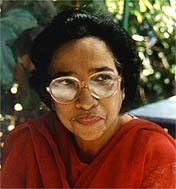
SAROJINI NAIDU – THE NIGHTINGALE OF INDIA


Hyderabad the “Pearl City of India” is a fascinating blend of past and present. Here cultures old and new coalesce into a colourful mosaic of architectural marvels, museums, parks and gardens, which transport the spell bound tourist from the forts and tombs of an elite Islamic past to Ramoji’s modern film city, from ancient purana havelis to the magnificent homes of the rich and famous on Jubilee Hills.

I searched in vain for the house where India’s nightingale was born. But like the mysterious veiled Rebecca in the Salar Jung Museum, Hyderabad has drawn a veil over her natal home.
“Sarojini Naidu ? Who?”
A blank look crossed the faces of those whom I asked, “Man, she must belong to Ancient history.”

Sarojini was born on the 13th of February, 1879 to Aghorinath Chattopadya a scientist, philosopher and educator, who founded the Nizam College, and a well known Bengali poetess Varadha Sundari Devi. Sarojini inherited the best genes of both her parents. She was something of a child prodigy, who passed her matriculation exam at the age of 13, and wrote a 1300 line poem on the Lady of the Lake in her early teens. She also wrote a play ‘Maher Muneer’ in Persian with some help from her father, which was well received in the literary world. The Nizam of Hyderabad was so impressed by her genius, that he offered her a scholarship to study abroad.

In 1895, at the age of 15, much against her will, she was sent to England. She studied at Kings College and Girton College Cambridge, rubbing shoulders with Arthur Symonds and Edmund Gausse. At this particular period in her life, she was influenced by the works of Tennyson, Shelley and Elizabeth Barret Browning, and her poems were western oriented. But Symonds and Gausse advised her to write on oriental themes – her own country, its mountains, rivers and people! She took their advice seriously. In her ‘Indian Love Song’ she wrote, “On ripe mango boughs of many coloured fruits, bright parrots cluster like vermilion flowers.” In her ‘Coromandel Fishers,’ she pictured “the wind asleep in the arms of dawn, like a child that has cried all night.”

Rich in imagery, her poems dealt with love and longing, separation and death. In ‘Ecstasy’ she talked of “the burden of love like the grace of a flower that is smitten with rain.”
Someone said that her poems had English words but an Indian soul.
Between 1905 and 1917, she published three volumes of poems – ‘The Golden Threshold,’ ‘Bird of Time,’ and ‘The Broken Wings,’ and won for herself the sobriquet “Nightingale of India.” Unfortunately today, her poems have been consigned to the archives. Modern poets call them “sentimental and mushy.” Others think they are “monotonous and boring.”
Poetry today has no rhyme or rhythm. Poems are mostly prose masquerading as poetry. No wonder Goethe said, “Modern poets mix too much water with their ink.”
Both Nehru and Tagore appreciated her poems.

Under the influence of Mahatma Gandhi, Sarojini channeled her energies into the Freedom Movement. When Gandhi was imprisoned in 1930, she took over the helm of the Movement. In 1931, she attended the Round Table Summit in London with Gandhi. Though she worked closely with him, she was never awed by his presence. In fact, she often teased him about his quirks. Many times she told him that the Freedom Movement lacked humour.
“May I confess privately that at odd intervals, I don’t feel very satyagrahic.”
She nicknamed Gandhi ‘Mickey Mouse’ and called him ‘My Little Man’ or ‘My Mystic Spinner.’ She never failed to remind him that it cost the exchequer a packet to keep him poor.

When Sarojini was sent to South Africa to encourage the Indians to fight against oppression, she wrote to Gandhi, “I cannot sleep in South Africa and its all your fault.”
Sarojini moved with politicians like Nehru, Gokhale, Malaviya and even Jinnah, whom she called ‘Ambassador of Hindu-Muslim Unity.’ Whether joining Gandhi in the Dandi March or participating in the movement against the Rowlett Act, she made her presence felt. In 1942, she was arrested during the Quit India Movement and was imprisoned for several months.

Sarojini was a feminist to the core. Her first defiance of tradition came at the age of 19, when she married a South Indian doctor Govindarajulu Naidu. It was an unacceptable union, as the doctor was a non-Brahmin. They married in 1898 under the Brahmo Samaj Act. This was a happy union, and she bore him four daughters.

Sarojini travelled extensively all over India giving lectures to youth on Dignity of labour, and Women’s Emancipation. She brought women out of their kitchens and championed their rights. She encouraged them to participate in politics. She wanted every woman to be aware of her self worth.
“We want a new breed of men before India can be cleansed of her diseases.”
“We want a deeper sincerity of motive, a greater courage in speech and earnestness in action.”
Oh how the modern day feminists would have embraced her!

Sarojini was the founder of the “Women’s India Association” and worked closely with Annie Besant and Margaret Cousins. She became the first governor of U.P. and died in Lucknow at the age of 70, on 2nd March 1949. On her 61st Death Anniversary, one recalls Nehru’s eulogy to the Nightingale of India.
“Here was a person of great brilliance…….a person vital and vivid…….of so many gifts, some of which made her unique. She infused artistry and poetry into the national struggle.”
One can only salute her indomitable spirit and her capacity to face difficulties “with a light heart and a song on her lips.”

Thursday, January 21, 2010

BERTHA VON SUTTNER – “Generalissimo of the Peace Movement.”

“The streets of Vienna are surfaced with culture as the streets of other cities with asphalt,” said Karl Krause. The city is a veritable gallery of Austrian art, with its artistic palaces and theatres designed by master architects and sponsored by royal patrons and wealthy landlords.

But in the midst of all these buildings is the Memorial Against War and Fascism, built in 1988 on the Albertina Platz. It is in memory of the sufferings of Austrians especially Jews in World War II. Three massive pillars in plaster of paris, stand upright in the Square, on which are engraved the bodies of mutilated men and women, with their aggressors standing above, wielding knives and staves. In between the pillars is the cast iron figure of a man scrubbing the floor. He represents the Jews who were made to scrub the streets clean, during that terrible period.

Even before World War I, Baroness Bertha von Suttner of Austria said, “Europe is one. Uniting it is the only way to prevent world catastrophe.” To this end she worked tirelessly, developing the concept of a society which would achieve peace through its people.

During her visit to Paris in 1887, Bertha heard of the International Peace and Arbitration Movement in London. She flew there to join the Movement and soon became its spokesperson, lecturing, writing and involving people all over the world.

Bertha von Suttner was born posthumously in Prague on June 9th, 1843. Her father Count Joseph Franz Kinsky was a Field Marshall and also the chamberlain to Emperor Franz
Joseph I. The Austrian society in which she grew up was seeped in military tradition. As an adult, Bertha opposed war. Her first book, “Lay Down Your Arms” published in 1889, was an indictment of militarism. In her second book “Machine Age” also published in 1889, she foretold the consequences of extreme nationalism and accumulation of arms. Her predictions came true two months after her death on June 21, 1914, with the outbreak of World War I.

Life was not always easy for Bertha. She tried various jobs to support herself. At the age of 30, she became tutor to the four daughters of Baron von Suttner, in Vienna. But she kept her intellectual life alive by reading and studying books on Science, History and Philosophy. She was also a musician.

Falling in love with the scion of the von Suttner family did not meet with the Baron’s approval. So she took off to Paris and worked as a secretary to Alfred Nobel. But after two years she could no more bear the separation from her lover and returned to Vienna. She was secretly married to Arthur Gundacear von Suttner on June 18, 1876, but had to live in Tiflis, Caucasus for nine years because of stern family opposition. The couple could return to Vienna only after reconciliation with the family in 1885.

In 1891, Bertha published a manifesto that led to the formation of the Austrian Peace Society. She was the only lady in a group of males. She also helped establish the German Peace Association and the International Peace Bureau in Geneva.

In 1899, at the first Peace Conference held in the Netherlands, she along with other peaceniks convinced the delegates of the need for a structure to resolve international conflicts. As a result, the Permanent Court of Arbitration came into existence.

Bertha’s friendship with Alfred Nobel began in 1876 and continued till the end of her life. The latter imbibed his pacifist ideas from her. She wrote, “Mr. Nobel and I exchanged several letters. He wrote soulful and intelligent letters but with a melancholic note. He seemed to be unhappy, misanthropic, highly cultured, and to own a deeply philosophical concept of the world.”
Her communications with Nobel are in the archives of the Nobel Foundation in Stockholm.

In 1905, Bertha was the first woman to receive the Nobel Prize for Peace. Today in a world rocked by violence and wars, Baroness Bertha von Suttner, the “Generalissimo of the Peace Movement” is forgotten, and the most influential book of the 19th century “Lay Down Your Arms,” with its distinct ant-military message, lies tucked away in some mouldy archive.

Monday, October 12, 2009

INKLINKS – NINE WOMEN, NINE VOICES!


Bangalore, the IT City of India was once the ‘Garden City’ of yester years. Many centuries ago, King Veera Ballala called it a ‘Village of Boiled Beans’ (Bengal-uru) to honour the generosity of an old woman who fed the hungry king with boiled beans, when he was traveling incognito. Today Bangalore is the home of writers of different styles and categories. Many of them have made their mark in the world of literature.

‘INKLINKS’ the latest group of women writers who have declared their love for pen and ink, are a motley group of nine women from different professional backgrounds –teachers, artists, journalists, clinical therapists, counselors and doctors. They have bonded in a very special way to write short stories mostly on contemporary issues, which make the readers want to laugh, cry, fume, fret or take up cudgels against the ills of society.
This is a closely knit group where members encourage, criticize and share useful information with each other. Most of them have had their short stories published in news papers, magazines and on the Net. Some are published authors. They are an ambitious lot, and their first anthology of short stories ‘BHELPURI’ is to be released on the 24th of October at the British Council Library.
Interacting with them is an exciting experience.

URSULA – PATRON SAINT OF YOUNG GIRLS


Most people who visit Cologne head for the Cologne Cathedral, which is one of the most important works of Gothic architecture in Europe. But the basilica of St. Ursula which is just a few streets away does not attract much attention. The revenues of this church go solely to the Abbess of the Ursuline Order and six other canonesses.

The story of Ursula a British princess is a sad one. She lived in the 5th century A.D. and was the daughter of King Donaut of Dummonia in south west England. Much against her wishes, she was betrothed to Governor Conan Meriodoc of Brittany. Ursula begged her father for a three-month reprieve, with the excuse that she wanted to go to Rome to be baptized.

Ursula sailed with 11 virgins for company. But a storm drove the vessel down to Cologne instead. Here this group of young women was martyred by the Huns in 453 A.D. Ursula was shot with an arrow. But the rest of the virgins were beheaded.

As time went by, a legend grew around Ursula and her band of virgins. She had an assistant called Undecimilla. Someone mistook this to be Undecim Millia meaning 11,000. And so the story spread that Ursula was accompanied by 11,000 virgins. But in 1969, Pope Paul VI called the story a figment of imagination, and removed Ursula from the canon of saints.

The Feast of Ursula is celebrated on the 21st of October. The Basilica dedicated to her is built on an ancient Roman cemetery. In the 16th century, the Romans slaughtered thousands of Christians not sparing even little children.

Attached to the Basilica is a chapel called the Golden Krammer, (Golden Chamber) which was built in the 17th century. This is a weird place of worship and guaranteed to give one goose pimples when one steps into the gloomy interior. Three walls of the chapel are lined by bones of different sizes and shapes – ribs, shoulder blades, femurs and other bones. They are artistically fixed into the walls in whorls, crosses, zigzag and even in the shape of Latin alphabets. Bones of very small children are also incorporated into this work of art. Sculptures of heads and torsos are exhibited in glass cases. Some skulls are encased in silver filigree. Others are covered with caps of gold and velvet. The skulls of the sculptures open up on top like lids, to reveal smaller skulls inside. The torsos are hollow like windows with grills, revealing skulls inside the abdomens.

Ursula’s statue shows her holding an arrow in one hand, (the weapon that killed her) and a pilgrim’s staff surmounted by a white banner with a red cross – the Christian standard of victory. A crown on her head shows that she is a princess. Many pilgrims come here believing that if they touch the bones of these martyrs, miracles would take place in their own lives. The pilgrims always carried back relics that were sold in the chapel.

There is no artificial cooling here. The temperature remains at a constant
18 degrees centigrade. Two stained glass windows on the outer wall let in some light.

There are large concrete sarcophagi both inside and outside the chapel containing millions of bones recovered from the cemetery, over which the church was built. It is said that during World War II, the chapel was protected by a slab of concrete. Though the rest of the Basilica was bombed, the chapel remained untouched.

Ursula is the patron saint of young girls because she and her virgins were young women when they were martyred. The Order of the Ursulines was established in 1535, by a woman called Angela Merci. This Order is devoted to the education of young girls.

Tuesday, August 25, 2009

LADY GODIVA – THE NAKED CRUSADER.


The Coventry Cathedral in England rose like a phoenix from the ruins of the bombed out St. Michael’s Church. In 1940, the Luftwaffe in its ‘Operation Moonlight Sonata,’ reduced to rubble the City of Coventry. The Germans reckoned without the faith and resilience of the people, who on the very next day decided that they would rebuild the Cathedral. Though it took fifteen years for this to happen, the Cathedral today stands proudly as a magnificent modern ‘theatre of worship.’

Beside it stand the ruins of the old church, open to the skies and still considered consecrated ground. Its tower and spire 295 feet high, loom into the skies. The Altar of Reconciliation holds pride of place, but there are many other plaques engraved on the walls. The words “Father Forgive” inscribed on the partially burnt out cross, spell the ethos of the Christian Church.

Most people fail to notice the remnants of very old buildings at the entrance to the Visitors’ Centre. These are the ruins of the earliest church in Coventry, which was dedicated to St. Mary. It was founded as a Benedictine Nunnery by Leofric, Earl of Mercia and his wife Godiva in 1043. With the dissolution of monasteries in 1539, the building fell into decay.

Most of us remember Lady Godiva because of the legend associated with her name. Some women strip for a living; some do it for a lark. Some do it for publicity, but the lovely lady of Coventry did it for a worthy cause. In the 11th century, her husband Leofric levied crippling taxes on the people of Coventry. This saintly woman pleaded with her husband to remit his orders. He agreed to do it on one condition – that she ride naked through the streets of Coventry. A decree was sent out to the people to stay indoors during this time, and bolt their windows and doors. But a tailor who was later called ‘Peeping Tom’ couldn’t contain his curiosity. He drilled a hole in his door to catch a glimpse of the naked lady, but was immediately struck blind.
One wonders why a godly man like Leofric wanted to humiliate his wife. Was it a form of sexual sadism? Or did he want to test whether she was genuinely concerned about her subjects? Her readiness to take up the challenge must have convinced him of her sincerity, and the taxes were promptly withdrawn.
The people of Coventry did not forget the goodness of Godiva. She has been immortalized in black marble. Her naked statue astride a horse, covered only by her cascading hair, stands under a canopy at the Cathedral’s Lane Shopping Centre.
Godiva lived between 997 – 1067 A.D. She was a widow when Leofric married her. Both of them were benefactors of religious houses. After Leofric’s death she was the only woman in England with such major land holdings.

A commemoration of Godiva’s legendary ride was instituted on May 31st 1678, and continued till 1960. But in 1980 after a gap of twenty years, a Coventry resident called Pru Porretta took on the role of present day Godiva. She leads a procession through town on Godiva’s birthday, which culminates in a celebration at the Cathedral ruins. Her aim is to bring various ethnic, cultural and religious communities together, through music, dance and story telling. Her band of helpers, are known as the Godiva Sisters.

Pru breathes the spirit of Godiva. She works with schools and communities, and brings the story of Godiva to life. Her conducted tours through the city are interesting and informative. And for those who would like to explore the darker side of Coventry, she conducts ghost tours too.

Monday, August 3, 2009

Katherine von Bora – Mistress Of The Black Cloister


.

A visit to Wittenberg was a pilgrimage long overdue. The town has been immortalized by Martin Luther, the monk who rebelled against the Catholic Church in the 16th century, for selling indulgences to gullible people, as a sacrament of penance. His act of nailing his 95 theses to the door of the Castle Church in Wittenberg was the beginning of the Protestant Reformation in Germany.

The entire town pays tribute to its hero through its churches, statues, Theological colleges and various other landmarks. But what struck me when I entered the Luther House where he lived and worked for many years, was the imposing sculpture of Katherine von Bora, a woman who defied tradition and shocked the Christian world of the 16th century with her daring-do. Few applauded her courage. Most thought she was a schemer. Her enemies were many, and friends just a handful. But she proved herself a worthy mistress of the Black Cloister, the house given to Martin Luther by the Elector John, as his permanent residence.

Katherine lost her mother at an early age. Her father, who married again, abdicated his parental responsibilities and admitted her into a Benedictine Convent in Brehna as a boarder. Later, at the age of ten, she was inducted into the convent at Nimbschen for her vocation as a nun. She received a good education, but physical labour and limited quantities of food were part of convent discipline. The child in her must have rebelled against such a difficult and Spartan lifestyle. It was also a cloistered existence with hardly any scope for mingling with the public.

By then, Martin Luther’s Reformation was gaining ground. Based on his deep study of the Bible, he refuted many of the restrictions of the Catholic Church. He realized that sexuality was God’s gift to mankind and was an inseparable part of human nature. Therefore priests should be allowed to marry if they so desired.

Luther’s revolutionary statements made their way through the hitherto impenetrable portals of Katherine’s convent. It incited Katherine and eight other fugitive nuns to flee the convent. They hid themselves in the wagon of a wholesaler Leonard Kopp, who brought goods regularly to the institution. Hidden behind his large fish barrels, they fled to Wittenberg, hoping that the great reformer would take care of their future. They were completely without means or plans, but with a ring leader like Katherine, they were sure that things wouldn’t go wrong.

Luther felt responsible for their resettlement. Some were given in marriage to his friends. Others went back to their parental homes. But Katherine remained, as no one would take her for a wife. She lived as a domestic help in the house of Lucas Cranach the painter.

Luther had no intention of marrying Katherine. He thought she was proud and arrogant. But in the end, because of her growing restlessness and lack of other suitors, he was persuaded to take her as his wife. Critics hollered that Martin had started the Reformation merely to satisfy his sexual needs. Katherine the runaway nun had married her pimp Luther after living in sin for over a year, they said. They predicted that the anti-Christ would be born from the union of a sex-starved nun and a degenerate monk. But these rumours were disproved when the couple had six normal children.

There was nothing passionate about their union. He was forty one and she was twenty six years old. Katherine craved for respectability through marriage to a famous man. The thought of presiding over his home excited her. Practical and down to earth, her management skills overrode Luther’s other-worldliness. His monetary status couldn’t put bread on the table for his family. But when Katherine took over, she initiated many money making schemes such as rearing domestic animals for food and milk, planting kitchen gardens for vegetable and fruit, and providing meals for students of theology.

Luther House is now a museum where one can visit the rooms where he worked and lived. His extensive library of books and manuscripts, photographs, paintings and personal belongings are on all display here.

Katherine’s yearning to possess land and property became an obsession. Though there was much criticism, she had the patronage of the Elector. Most of her economic endeavours were done without Luther’s knowledge. Theirs was not an intellectual partnership, and she had no influence whatsoever over his sermons and writings. But Luther did admire her skills in money management, and always took her side against adverse criticism.
“In domestic duties I defer to Kate,” he said, “Otherwise I am led by the Holy Spirit.”

Katherine was ugly with a long nose and stubborn chin, but she had intelligence and personality. Some biographers describe her as a “quick witted Saxon with a ready tongue.”

After Luther’s death, Katherine lived on at the Black Cloister with her children. But in 1546, when Saxony was in a state of war, she fled to Madgeburg for a while. She lost a lot of her money and property. She returned to Wittenberg in 1548, until the Black Plague threatened the area. Now she fled to Torgau with her family. But her carriage met with an accident, and she suffered injuries. She also suffered a chill from which she never recovered. She died on December 20th, 1552, and was buried at the Church of St. Mary in Torgau.

The marriage of the runaway nun and the rebel monk created history and brought about Luther’s break with monasticism and clericalism. Katherine provided him with the means and the privacy to pursue his writing, teaching and preaching activities.

Katherine loved being wealthy and in total control of her fiefdom the Black Cloister. She was a woman who could shake off animosity and criticism with a decisive shrug of her broad shoulders.

Saturday, June 27, 2009

HILDA MUNTHE-LONELY MISTRESS OF HILDASHOLM.


The drive from Stockholm to Dalarna County in the north west of Sweden is about three hundred kms. It winds through miles and miles of conifer forests interspersed with fields of wheat and rye. Here and there among the greenery are clusters of red roofed cottages that paint a pretty picture against the dark green shades of the forest. The roofs have low maintenance as the red paint comes from copper mining debris in the region, mixed with arsenic and other chemicals. It ensures the durability of the wooden constructions and keeps them termite free.

My destination is Leksand on the banks of the Siljan Lake. Three hundred million years ago a meteor fell over Dalarna, and this large lake was born. On its banks are many picturesque villages. Leksand is one of them. The houses here are surrounded by sprawling lawns. Terraces of multicolored flowers and lush green meadows reach down to the water’s edge.

Hildasholm, a 14-roomed mansion overlooking the lake has a very romantic setting. The Nature Park surrounding this mansion has been artistically landscaped into several small colourful gardens, amidst patches of untamed jungle. They are patterned after English gardens, and many of the plants and sculptures have also been imported from England. Wandering through the yellow peacock garden, the evergreen junipers, and the green arch temple makes one feel like Alice in Wonderland. There is a medicinal garden in memory of the famous Swedish doctor and author Axel Munthe. The fountain garden with its fountain surrounded by granite pillars which are topped with iron urns, was opened by Queen Victoria of Sweden in 1924.

This ornamental landscape is the untiring work of Hilda Munthe the second wife of Axel Munthe, who lived in the early 20th century. He was a great nature lover and fell in love with the beauty of Leksand. He built the Hildasholm Mansion earlier known as ‘Stone Court,’ as a wedding present for his young wife Hilda Pennington Mellor. She toiled for ten years to turn this wild park around the mansion into a thing of beauty.

Yet Munthe never lived here. He resided permanently on the Isle of Capri, in his Villa St. Michael, attending to his patients or traveling around Europe on his various errands of mercy. When not preoccupied with his profession, he was in the company of the chronically ill Princess Victoria of Sweden, both as her physician and close friend. She always spent the long winter months in Capri.

Though the Princess was married to Crown Prince Gustav, she found him uncultured and boring. Munthe was her soul mate. She shared his love of Arts, Music and Photography. People gossiped but there was nothing much they could do. The Princess and Munthe traveled together to Venice. The duo even teamed up in concert, she playing the piano and his rich tenor ringing out in song. Though he was pursued by rich and famous women, Munthe was obsessed with the princess. “You are the woman of my heart,” he said.
This relationship was probably the cause of his divorce from his first wife.

But as he aged, he realized the futility of this liaison. They could never marry. He longed for a wife and family. So in 1910, he chose a bride from the English aristocracy, the young Hilda Pennington Mellor. Though she bore him two sons, she hated living in Capri because of his relationship with the Princess. She was jealous not only of Victoria but suspicious of all the other women who fawned over him. They separated in 1919, and Hilda left Capri for good.

Ironically, Munthe’s marriage brought a chill into his relationship with the Princess. Her visits to Capri became less frequent. Even so, when she was crowned queen, she appointed Munthe as her personal physician. They eventually fell out with each other over political differences. But he was by her side when she died in 1930.
Axel Munthe returned to Sweden only when he was old and almost blind. He dedicated his book ‘The Story of St. Michael” to the Princess.

Hilda spent her summers at Hildasholm with her two sons, opening her soul to Nature and allowing the beauty and tranquility of her gardens to bring her peace. If only those gardens could speak, they would tell the story of a sad and neglected wife, who watered the flower beds with her tears as she whispered, ‘With all thy faults I love thee still.’
She died in 1967.

Today Hildasholm and its gardens are owned by the Stifteson Foundation run by the Leksand Church and the Municipality. It was donated to the county by her son Malcolm in 1980.